Singapore SME Stationery Procurement: Why Small Businesses Pay 23-41% More Than Enterprises for the Same Products
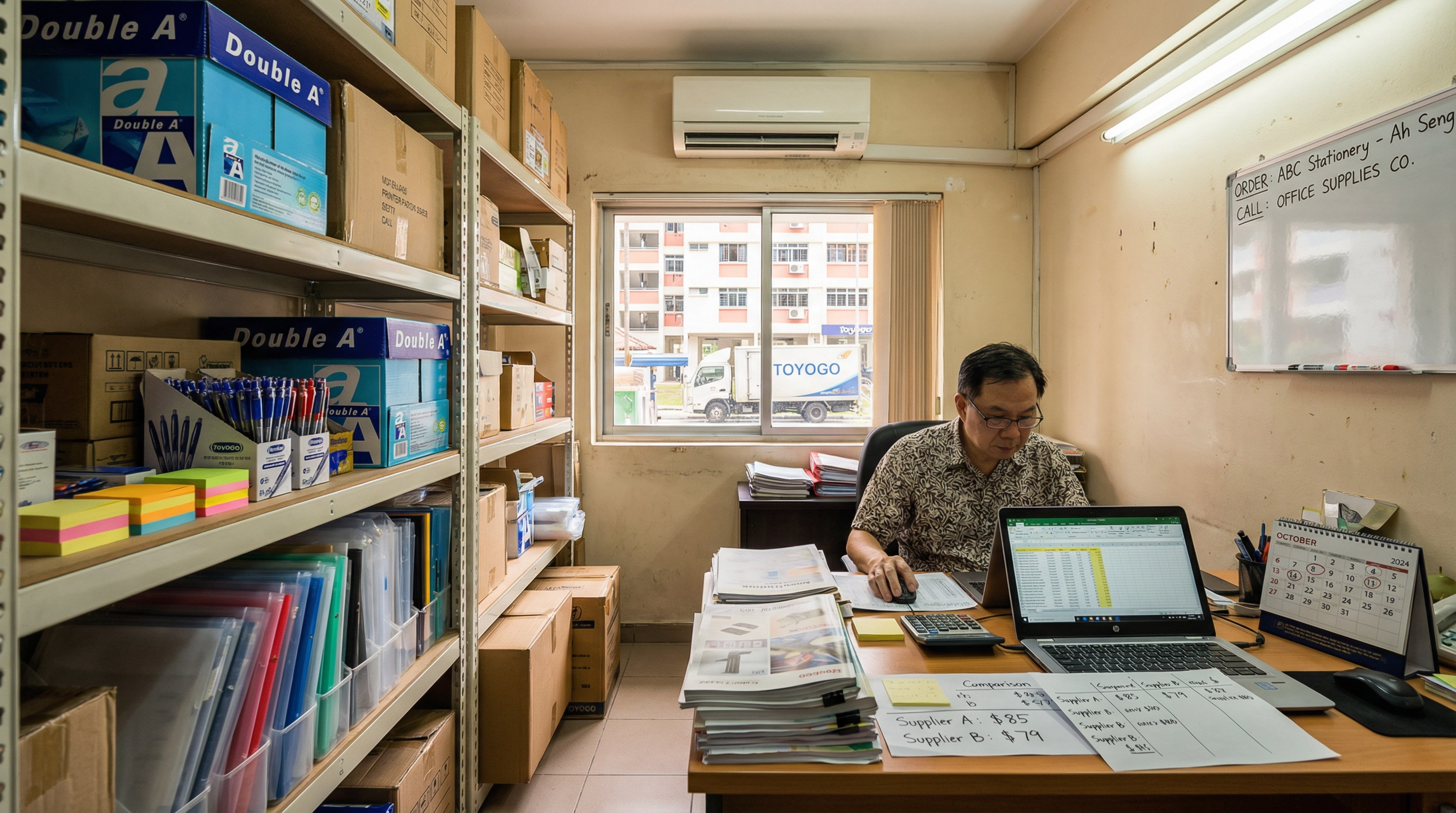
When Sarah Lim opened her boutique marketing consultancy in a Tanjong Pagar shophouse in March 2024, she assumed that sourcing office stationery for her six-person team would be straightforward—Singapore's reputation for efficient business infrastructure suggested that competitive suppliers would be readily accessible. Her assumption proved costly. After requesting quotes from five major Singapore stationery distributors for a modest initial order (500 branded notebooks, 1,000 promotional pens, and standard office supplies), she received responses ranging from "our minimum order is SGD 3,000" to pricing that was 38% higher than the per-unit costs her previous employer (a multinational bank) paid for identical products. The few suppliers willing to accept her SGD 1,200 order quoted delivery times of 3-4 weeks and required full payment upfront—terms that larger enterprises never face.
Sarah's experience reflects a structural reality of Singapore's stationery market: small and medium enterprises (SMEs) operate at a systematic disadvantage compared to corporate buyers. Enterprise procurement departments leverage economies of scale, established supplier relationships, and professional negotiating expertise to secure pricing that SMEs cannot access. A 2024 survey by the Singapore Business Federation found that SMEs with fewer than 20 employees pay an average of 28% more per unit for common office supplies compared to enterprises with 200+ employees purchasing the same products from the same suppliers. This "SME premium" compounds over time—a small business spending SGD 800 monthly on stationery pays approximately SGD 2,700 annually in excess costs compared to what an enterprise would pay for equivalent purchases.
The root cause of this price disparity lies in minimum order quantities (MOQs) and volume-tiered pricing structures. Most Singapore stationery distributors structure their pricing in tiers: retail pricing (for walk-in customers buying small quantities), small business pricing (for orders above SGD 500-1,000), corporate pricing (for orders above SGD 5,000-10,000), and enterprise contract pricing (for annual agreements above SGD 50,000). The per-unit price difference between retail and enterprise tiers can reach 45% for commodity items like ballpoint pens and 35% for custom-printed products like branded notebooks. SMEs typically purchase in quantities that qualify only for retail or small business pricing, while enterprises' consolidated purchasing power places them in corporate or enterprise tiers.
Consider a concrete example: a standard Pilot G-2 0.7mm gel pen retails for SGD 2.20 at Popular bookstore, costs SGD 1.85 per unit for small business orders of 100+ units (16% discount), SGD 1.55 per unit for corporate orders of 1,000+ units (30% discount), and SGD 1.35 per unit for enterprise contracts of 10,000+ units annually (39% discount). An SME needing 50 pens quarterly (200 annually) pays SGD 440 per year at retail pricing or SGD 370 if they can meet the 100-unit MOQ by ordering six months' supply at once. An enterprise needing 200 pens quarterly (800 annually) pays SGD 1,080 at enterprise pricing—SGD 1.35 per pen versus the SME's SGD 1.85-2.20, a 27-39% premium for the same product.
The MOQ barrier creates a secondary problem: inventory carrying costs and cash flow strain. When Sarah's consultancy orders six months' worth of pens to meet supplier MOQs, she ties up working capital in inventory that sits on shelves for months, occupies limited storage space in her shophouse office, and risks obsolescence if her branding changes or the business pivots. Enterprise procurement departments have dedicated warehouses, inventory management systems, and sufficient cash reserves that carrying three to six months of stationery inventory is operationally trivial. For an SME operating on thin margins with limited storage space, the choice between paying retail premiums for small frequent orders versus meeting MOQs through large infrequent orders is a lose-lose proposition.
Supplier access presents another challenge. The premium stationery brands and specialized suppliers that serve Singapore's MNC market often decline to work with SMEs entirely, viewing small orders as administratively burdensome and unprofitable. Sarah discovered this when attempting to source eco-friendly notebooks made from recycled paper—three suppliers she contacted required minimum orders of 5,000 units (representing 10 years of usage for her team) or referred her to retail channels where per-unit costs were 52% higher than the corporate pricing her previous employer paid. The suppliers' logic is economically rational: processing a SGD 1,200 order requires nearly the same administrative effort (order entry, credit checks, invoicing, delivery coordination) as processing a SGD 12,000 order, but generates one-tenth the revenue. From the supplier's perspective, focusing on high-value enterprise accounts and declining small SME orders maximizes profitability.
Payment terms compound the disadvantage. Enterprise buyers typically receive 30-60 day payment terms, allowing them to receive and use products before paying suppliers—effectively an interest-free loan that improves cash flow. SMEs, especially new businesses without established credit histories, face demands for prepayment or cash-on-delivery. When Sarah requested 30-day terms from a supplier, she was told that "net-30 terms are available for accounts with annual purchasing above SGD 10,000 and established payment history"—a catch-22 where she needs credit history to get credit terms, but cannot build credit history without first receiving credit terms. The working capital impact is significant: prepaying SGD 1,200 for stationery that will be consumed over three months means Sarah's cash is tied up an average of 45 days before the products are actually used, while her enterprise competitors pay 30 days after consumption, a 75-day cash flow advantage.
Geographic factors specific to Singapore exacerbate these challenges. Singapore's high commercial real estate costs (averaging SGD 8-12 per square foot monthly for industrial space in 2024) push stationery distributors to optimize warehouse efficiency by focusing on high-value, high-volume accounts. A distributor storing 500 cartons of products for an enterprise client generating SGD 200,000 annual revenue uses warehouse space far more profitably than storing 50 cartons for an SME generating SGD 5,000 annually. This economic reality means that distributors design their operations around enterprise needs—large delivery trucks optimized for pallet-quantity shipments to corporate offices, not small vans for delivering a few cartons to shophouse businesses in Tanjong Pagar or Chinatown.
The lack of SME-focused aggregation platforms in Singapore's stationery market represents a missed opportunity. In other markets, group purchasing organizations (GPOs) aggregate demand from multiple small businesses to achieve enterprise-level volumes and negotiate corresponding pricing. A GPO might combine orders from 50 SMEs, each needing 200 pens annually, to create a consolidated 10,000-unit order qualifying for enterprise pricing, then distribute the products to member businesses while passing through the cost savings. Singapore has GPOs in healthcare and hospitality sectors, but stationery procurement remains fragmented, with each SME negotiating independently and failing to capture volume discounts.
Sarah eventually developed a hybrid sourcing strategy that reduced her stationery costs by 19% compared to her initial retail purchasing. She identified three tactics that work within Singapore's market structure. First, she joined an informal buying cooperative with four other small consultancies in her building, pooling quarterly orders to meet supplier MOQs and splitting delivery costs. Their combined purchasing of 1,000 pens quarterly qualifies for corporate pricing tier, saving each business approximately SGD 120 quarterly (SGD 480 annually). Second, she shifted commodity purchases (basic ballpoint pens, copy paper, folders) to Shopee Business and Lazada's B2B platforms, where competition among sellers drives prices closer to wholesale levels even for small quantities. Third, she negotiated annual contracts with two suppliers for her most frequently purchased items, committing to minimum annual volumes (SGD 4,000 with each supplier) in exchange for corporate pricing and 30-day payment terms.
The Shopee Business and Lazada B2B platforms deserve particular attention as they represent a structural shift in Singapore's SME stationery procurement landscape. These platforms aggregate supply from multiple distributors and manufacturers, creating price transparency and competition that traditional distribution channels lack. Sarah found that basic A4 copy paper (5 reams) costs SGD 18.50 from traditional distributors at small business pricing, but SGD 14.20 on Shopee Business from sellers offering free delivery for orders above SGD 50—a 23% savings. The platforms' buyer protection policies (money-back guarantees, dispute resolution) also reduce the risk of dealing with unfamiliar suppliers, addressing a concern that makes many SMEs stick with established (but expensive) distributors.
However, e-commerce platforms have limitations for specialized or custom-branded products. When Sarah needed notebooks with her consultancy's logo, Shopee Business sellers quoted MOQs of 500-1,000 units and 3-4 week production times—no better than traditional distributors. She eventually found a solution through a regional supplier in Malaysia who specializes in small-batch custom printing (MOQ 100 units, SGD 4.20 per unit including printing, 10-day turnaround). The cross-border sourcing added complexity (managing SGD-MYR exchange rates, coordinating delivery across the Causeway, navigating customs documentation), but saved 31% compared to Singapore suppliers' quotes for equivalent products.
The regulatory environment offers some support for SME procurement, though awareness is limited. Enterprise Singapore's SME Centres provide business advisory services including procurement guidance, and the Productivity Solutions Grant (PSG) subsidizes up to 50% of costs for approved digital procurement tools and inventory management systems. However, these programs focus primarily on manufacturing and service sector procurement rather than office supplies, and many SMEs are unaware that stationery purchasing could qualify for PSG support if implemented as part of a broader procurement digitalization initiative.
Looking forward, several trends may reduce the SME premium in Singapore's stationery market. The growth of coworking spaces (WeWork, JustCo, The Working Capitol) that provide shared office supplies as part of membership packages reduces stationery procurement burden for the smallest SMEs—though at the cost of losing brand customization and control over product selection. The expansion of regional e-commerce platforms (Alibaba.com, Made-in-China.com) offering direct factory sourcing enables SMEs to bypass Singapore distributors entirely for large orders, though this requires navigating international shipping, customs clearance, and quality verification without local intermediaries.
The emergence of subscription-based stationery services represents another potential solution. Several startups in Singapore now offer monthly stationery subscription boxes tailored to SME needs—delivering a curated selection of office supplies at fixed monthly fees (typically SGD 80-150 for teams of 5-10 people). The subscription model eliminates MOQ barriers and inventory management burden, though it sacrifices customization and may not be cost-competitive for businesses with very specific product requirements or highly variable consumption patterns.
For SME owners navigating Singapore's stationery procurement landscape, the key lesson from Sarah's experience is that accepting retail pricing as inevitable is a costly mistake. While SMEs cannot match enterprise purchasing power, strategic approaches can narrow the price gap significantly. Forming informal buying cooperatives with neighboring businesses, leveraging e-commerce platforms for commodity items, negotiating annual contracts for high-volume products, and exploring cross-border sourcing for custom items collectively can reduce stationery costs by 15-25%—meaningful savings for businesses operating on tight margins. The effort required (researching suppliers, coordinating with other businesses, managing multiple vendor relationships) is non-trivial, but for an SME spending SGD 10,000-15,000 annually on stationery, capturing SGD 2,000-3,000 in savings represents a worthwhile return on procurement optimization time.
Related Articles:
- Singapore Retail vs. B2B Stationery Pricing Structure
- Singapore Co-Working Space Shared Stationery Supply Models
- Vendor-Managed Inventory Implementation Case Study
SME struggling with stationery procurement costs? ATLAS STATIONERY LAB™ offers flexible MOQs and SME-friendly pricing for Singapore small businesses. Request a quote tailored to your team size and budget, or explore our product catalog designed for businesses of all sizes.