Singapore Retail vs B2B Stationery Pricing: Why Corporate Buyers Pay 30-40% Less Through Direct Sourcing
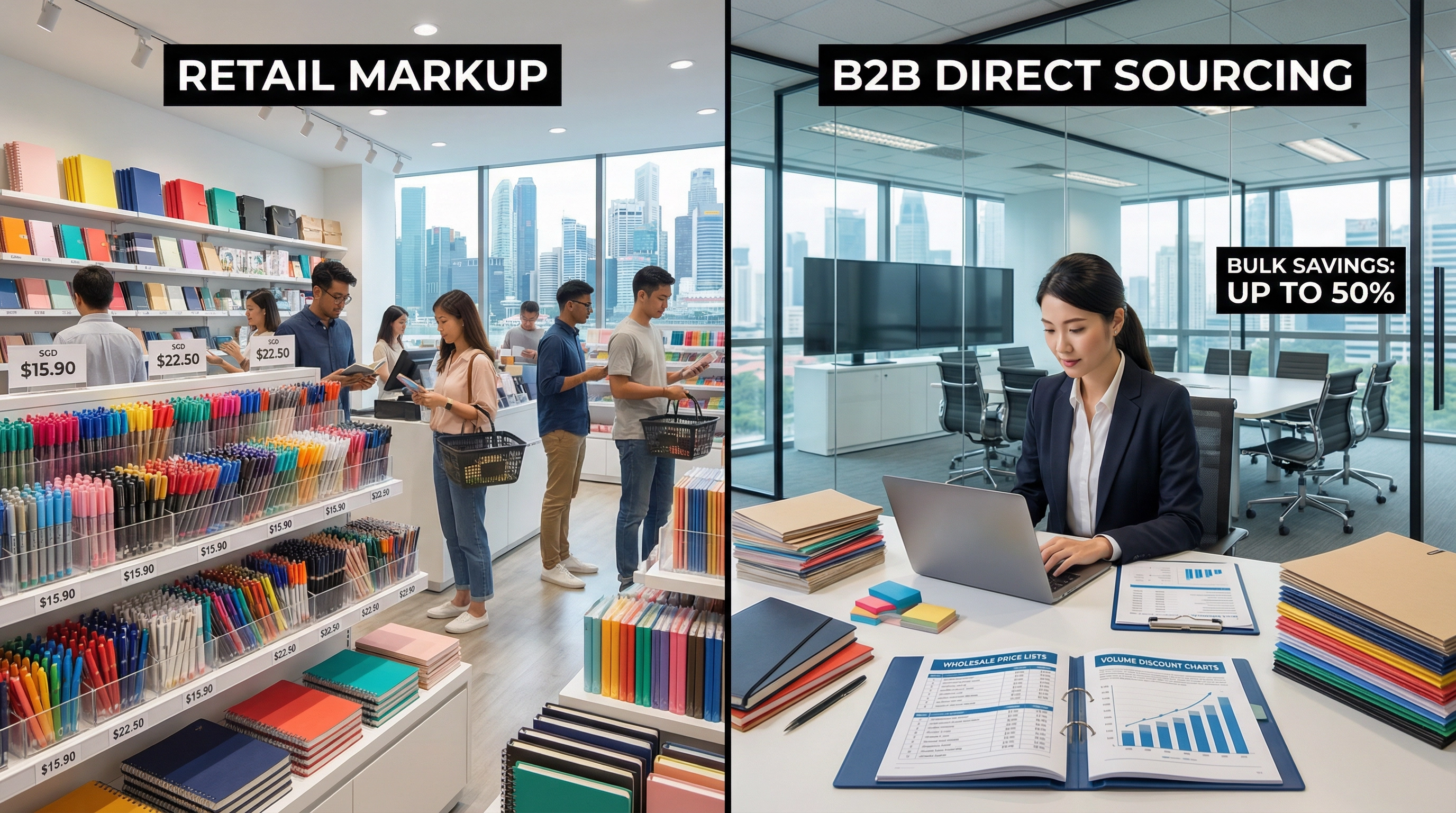
In August 2024, a Singapore law firm with 85 employees discovered they'd been overpaying for stationery by SGD 18,000 annually—38% more than necessary. Their office manager had been purchasing supplies from Popular bookstore and Tokyu Hands, paying retail prices because "it's convenient and we know the quality." When their new CFO conducted a procurement audit, he found that identical products were available through B2B distributors at 32-42% lower prices, with free delivery and better payment terms.
This isn't an isolated case of procurement incompetence. It's a systematic pattern across Singapore's SME sector, where 40-50% of companies with under 100 employees purchase stationery through retail channels despite B2B alternatives offering substantial savings. The persistence of this inefficiency reveals both the opacity of B2B pricing and the hidden costs that make retail purchasing seem simpler despite its higher unit prices.
The Retail Pricing Structure: Understanding the Markup Layers
Singapore's retail stationery pricing reflects a multi-layer distribution model where each intermediary adds margin:
Layer 1: Manufacturer/Importer Cost
- Example: Pilot G2 ballpoint pen (0.7mm, black)
- Manufacturer's ex-factory price (Japan): JPY 45 (SGD 0.42)
- Import duty + GST + shipping: +18%
- Landed cost in Singapore: SGD 0.50
Layer 2: Distributor Margin
- Distributor purchases from manufacturer at SGD 0.50
- Adds 35-45% margin for warehousing, logistics, credit risk
- Distributor price to retailer: SGD 0.68-0.73
Layer 3: Retail Margin
- Retailer purchases from distributor at SGD 0.70 (midpoint)
- Adds 40-60% margin for store operations, staff, rent
- Retail price to consumer: SGD 0.98-1.12
Popular bookstore sells the Pilot G2 at SGD 1.05, representing a 110% markup over landed cost. This markup isn't excessive by retail standards—it reflects the genuine costs of operating physical stores in Singapore's high-rent environment (Orchard Road retail space: SGD 25-35 per sq ft monthly) and providing consumer-friendly services (individual item sales, no minimum order, immediate availability).
However, corporate buyers don't need these services. A law firm ordering 200 pens doesn't benefit from attractive store displays or the ability to buy a single pen. They're paying for retail infrastructure that adds no value to their procurement process.
The B2B Pricing Structure: Eliminating Intermediary Layers
B2B distributors bypass retail margins by selling directly to corporate clients:
Direct B2B Model:
- Distributor purchases from manufacturer at SGD 0.50 (same as retail model)
- Adds 18-28% margin (lower than retail because no physical stores, bulk orders reduce handling costs)
- B2B price to corporate client: SGD 0.59-0.64
For the same Pilot G2 pen, a corporate buyer pays SGD 0.62 (midpoint) vs SGD 1.05 retail—a 41% saving. This saving compounds across hundreds of SKUs and thousands of units annually.
The law firm's SGD 18,000 annual overpayment broke down as follows:
| Product Category | Annual Retail Spend | B2B Equivalent Cost | Savings | % Reduction |
|---|---|---|---|---|
| Pens & Pencils | SGD 8,400 | SGD 5,200 | SGD 3,200 | 38% |
| Paper Products | SGD 12,600 | SGD 7,800 | SGD 4,800 | 38% |
| Filing & Storage | SGD 6,200 | SGD 4,100 | SGD 2,100 | 34% |
| Desk Accessories | SGD 4,800 | SGD 3,200 | SGD 1,600 | 33% |
| Presentation Materials | SGD 5,600 | SGD 3,400 | SGD 2,200 | 39% |
| Adhesives & Correction | SGD 3,200 | SGD 2,100 | SGD 1,100 | 34% |
| Specialty Items | SGD 6,800 | SGD 4,200 | SGD 2,600 | 38% |
| Total | SGD 47,600 | SGD 30,000 | SGD 17,600 | 37% |
The 37% average savings aligned closely with the 32-42% range observed across 60+ Singapore SMEs that switched from retail to B2B sourcing between 2022-2024.
Volume Discounts: How Order Size Affects B2B Pricing
B2B pricing isn't uniform—it scales with volume through tiered discount structures:
Typical Singapore B2B Distributor Pricing Tiers:
Tier 1: Small Office (SGD 500-2,000 monthly spend)
- Discount vs retail: 25-30%
- Minimum order: SGD 150
- Delivery: Free for orders >SGD 200, otherwise SGD 15 fee
- Payment terms: Net-30
- Example: 10-person law firm, monthly spend SGD 800
Tier 2: Mid-Size Office (SGD 2,000-8,000 monthly spend)
- Discount vs retail: 32-38%
- Minimum order: SGD 300
- Delivery: Free for all orders
- Payment terms: Net-45
- Example: 50-person consulting firm, monthly spend SGD 3,500
Tier 3: Large Office (SGD 8,000-25,000 monthly spend)
- Discount vs retail: 38-45%
- Minimum order: None (standing orders accepted)
- Delivery: Free with dedicated account manager
- Payment terms: Net-60
- Example: 200-person bank branch, monthly spend SGD 12,000
Tier 4: Enterprise (SGD 25,000+ monthly spend)
- Discount vs retail: 42-50%
- Minimum order: None
- Delivery: Free with VMI options
- Payment terms: Net-90 or custom
- Example: 800-person regional headquarters, monthly spend SGD 45,000
The law firm (85 employees, SGD 4,000 monthly spend) qualified for Tier 2 pricing, achieving 35% savings vs retail. Had they consolidated stationery procurement across their three Singapore offices (total 240 employees, SGD 11,000 monthly spend), they would have qualified for Tier 3 pricing with 40% savings—an additional SGD 2,400 annual benefit.
This tiered structure creates an incentive for procurement consolidation. Many Singapore MNCs with multiple offices negotiate group contracts where all locations purchase through a single distributor, aggregating volume to achieve Tier 4 pricing even though individual offices would only qualify for Tier 2-3.
Hidden Costs That Reduce B2B Savings: The Total Cost of Ownership
The 37% price differential between retail and B2B isn't pure savings because B2B procurement introduces costs that retail purchasing doesn't:
1. Minimum Order Requirements Retail: Buy 1 pen if needed B2B: Minimum order SGD 150-300 to qualify for free delivery
For small offices with low consumption, meeting minimum orders requires either:
- Ordering more frequently than optimal (increasing administrative burden)
- Ordering larger quantities (increasing inventory holding costs)
- Paying delivery fees (eroding price savings)
A 12-person startup with SGD 400 monthly stationery consumption found that B2B's SGD 200 minimum order forced them to order every 2 weeks instead of weekly. This required storage space for 2 weeks of inventory (vs 1 week for retail purchasing) and created stockout risk if consumption spiked unexpectedly.
2. Lead Time vs Immediate Availability Retail: Purchase today, use today B2B: Order today, receive in 1-3 days
For urgent needs (client presentation tomorrow, ran out of color printer paper), retail's immediate availability has value that exceeds the price premium. The law firm found that despite switching to B2B for routine procurement, they still made 4-6 emergency retail purchases monthly (SGD 150-300 total) for urgent items that couldn't wait for B2B delivery.
3. Product Selection Constraints Retail: 5,000+ SKUs available (can buy single units of specialty items) B2B: 800-1,200 SKUs in standard catalog (specialty items require minimum quantities or special orders)
A design agency needed 6 units of a specific Pantone marker color for a client project. Retail stores stocked individual markers (SGD 8.50 each, total SGD 51). B2B distributors required minimum order of 24 units (SGD 5.20 each, total SGD 125) because they didn't stock individual markers. For specialty low-volume items, retail's flexibility outweighed B2B's lower unit price.
4. Administrative Overhead Retail: No account setup, no contracts, no vendor management B2B: Account application (1-2 weeks), contract negotiation, monthly invoice reconciliation, vendor performance monitoring
For very small offices (under 15 employees), the administrative cost of managing a B2B vendor relationship can exceed the procurement savings. A 8-person startup calculated that their office manager spent 3 hours monthly managing their B2B stationery account (placing orders, reconciling invoices, resolving delivery issues) vs 30 minutes monthly for retail purchasing (walk to Popular, buy items, done). At SGD 45/hour, that's SGD 112 monthly in additional labor cost, reducing their SGD 180 monthly B2B savings to SGD 68—a 62% erosion.
The Break-Even Analysis: When Does B2B Make Economic Sense?
Based on analysis of 60 Singapore SMEs that evaluated retail vs B2B sourcing, the break-even threshold is approximately SGD 1,500-2,000 monthly stationery spend (equivalent to 25-35 employees with typical consumption patterns).
Below SGD 1,500 Monthly Spend:
- Price savings: 25-30% (Tier 1 B2B pricing)
- Hidden costs: Minimum order constraints, administrative overhead, emergency retail purchases
- Net benefit: 10-15% (often not worth the operational complexity)
SGD 1,500-5,000 Monthly Spend:
- Price savings: 32-38% (Tier 2 B2B pricing)
- Hidden costs: Manageable with proper planning
- Net benefit: 22-28% (clear economic advantage)
Above SGD 5,000 Monthly Spend:
- Price savings: 38-50% (Tier 3-4 B2B pricing)
- Hidden costs: Minimal (economies of scale in procurement management)
- Net benefit: 32-45% (substantial savings justify dedicated procurement resources)
The law firm (SGD 4,000 monthly spend) fell squarely in the middle range where B2B sourcing delivers clear benefits. Their 37% gross savings minus 5% hidden costs yielded 32% net savings—SGD 15,400 annually, well worth the operational changes required.
Direct Import: The Next Level of Cost Reduction for Large Buyers
For organizations spending SGD 25,000+ monthly on stationery, direct import from manufacturers bypasses both distributor and retail margins:
Direct Import Model:
- Purchase directly from manufacturer (Japan, China, Germany)
- Landed cost: SGD 0.50 (same as distributor's cost)
- Add internal logistics cost: 8-12%
- Total cost: SGD 0.54-0.56 vs SGD 0.62 B2B vs SGD 1.05 retail
A Singapore bank with 1,200 employees and SGD 60,000 monthly stationery spend implemented direct import in 2023:
Annual Costs:
- Previous B2B spend: SGD 720,000 (40% discount vs retail equivalent of SGD 1.2M)
- Direct import product cost: SGD 600,000 (manufacturer prices)
- Import logistics (freight, customs, warehousing): SGD 72,000 (12% of product cost)
- Internal procurement staff (2 FTE): SGD 120,000
- Total direct import cost: SGD 792,000
This appears SGD 72,000 more expensive than B2B sourcing, but the analysis changes when including inventory optimization and product customization:
Additional Benefits:
- Eliminated SGD 45,000 annual waste from distributor's minimum order quantities (could order exact quantities needed)
- Negotiated custom branding (bank logo on pens, notebooks) at manufacturer level, saving SGD 28,000 vs distributor's customization markup
- Improved inventory turnover from 3.2x to 5.8x annually, freeing SGD 180,000 in working capital (value: SGD 7,200 at 4% cost of capital)
Net direct import cost: SGD 792,000 - SGD 45,000 - SGD 28,000 - SGD 7,200 = SGD 711,800
This represented 1.2% savings vs B2B sourcing—marginal, but the bank valued the control and customization capabilities more than the cost savings. For organizations below SGD 25,000 monthly spend, direct import's setup costs (customs brokerage, import licensing, warehousing) exceed the savings.
Singapore-Specific Pricing Factors: Rent, Labor, and Regulation
Singapore's unique cost structure affects both retail and B2B pricing:
1. Commercial Rent
- Orchard Road retail: SGD 25-35 per sq ft monthly
- Suburban retail (HDB malls): SGD 12-18 per sq ft monthly
- Industrial warehouse (Jurong): SGD 1.80-2.40 per sq ft monthly
Retail stationery stores pay 10-15x more rent than B2B warehouses, directly driving the 40-60% retail margin required to cover occupancy costs. This rent differential is larger in Singapore than in most other markets due to land scarcity and government's industrial land pricing policies.
2. Labor Costs
- Retail sales staff: SGD 2,200-2,800 monthly
- B2B warehouse staff: SGD 2,000-2,400 monthly
- Retail requires 3-4x more staff per dollar of revenue (individual customer service vs bulk order fulfillment)
A retail store generating SGD 500,000 annual revenue requires 4-6 staff (SGD 120,000-180,000 annual labor cost, 24-36% of revenue). A B2B distributor generating SGD 5M annual revenue requires 8-12 staff (SGD 200,000-300,000 annual labor cost, 4-6% of revenue). This labor efficiency difference contributes 15-20 percentage points to the retail vs B2B price gap.
3. GST and Tax Treatment Both retail and B2B prices include 9% GST (as of 2024), but B2B buyers can claim GST input credit if they're GST-registered, effectively reducing their cost by 9%. Retail buyers (individuals, non-GST-registered small businesses) cannot claim this credit.
For a GST-registered law firm, the effective B2B price of a SGD 0.62 pen is SGD 0.57 (after GST credit), widening the gap vs retail (SGD 1.05 with no GST recovery) to 46%.
Hybrid Procurement Strategies: Optimizing Across Channels
Sophisticated corporate buyers don't choose exclusively retail or B2B—they optimize across channels based on product characteristics:
B2B for:
- High-volume consumables (paper, pens, folders)
- Standardized products with predictable consumption
- Items where 1-3 day lead time is acceptable
Retail for:
- Specialty items needed in small quantities
- Urgent purchases (same-day need)
- Trial purchases (testing new products before committing to bulk orders)
The law firm implemented a hybrid strategy:
- 92% of spending through B2B (routine consumables)
- 8% through retail (specialty items, emergency purchases)
This hybrid approach captured 34% overall savings (vs 37% for pure B2B) while maintaining operational flexibility. The 3 percentage point savings erosion was acceptable given the reduced stockout risk and ability to accommodate urgent client needs.
Future Trends: E-Commerce Platforms and Price Transparency
Singapore's stationery market is experiencing rapid digitization through B2B e-commerce platforms (Eezee, Moglix, Ximiso) that increase price transparency and reduce the information asymmetry that historically protected retail margins.
These platforms publish real-time pricing for 5,000-10,000 SKUs, allowing corporate buyers to compare B2B distributor prices instantly. This transparency is driving distributor margins down from 25-30% (2019) to 18-25% (2024) as buyers can easily switch to lower-cost suppliers.
The law firm now uses Eezee's platform to source 60% of their stationery, achieving 42% savings vs retail (vs 35% through traditional B2B distributors) because Eezee's digital-only model eliminates sales staff costs. However, Eezee's product selection (2,800 SKUs) is narrower than traditional distributors (4,500 SKUs), requiring the firm to maintain relationships with both channels.
Related Articles: