Singapore Education Sector Back-to-School Procurement Cycles: MOE Tender Schedules and Term-Based Demand Patterns
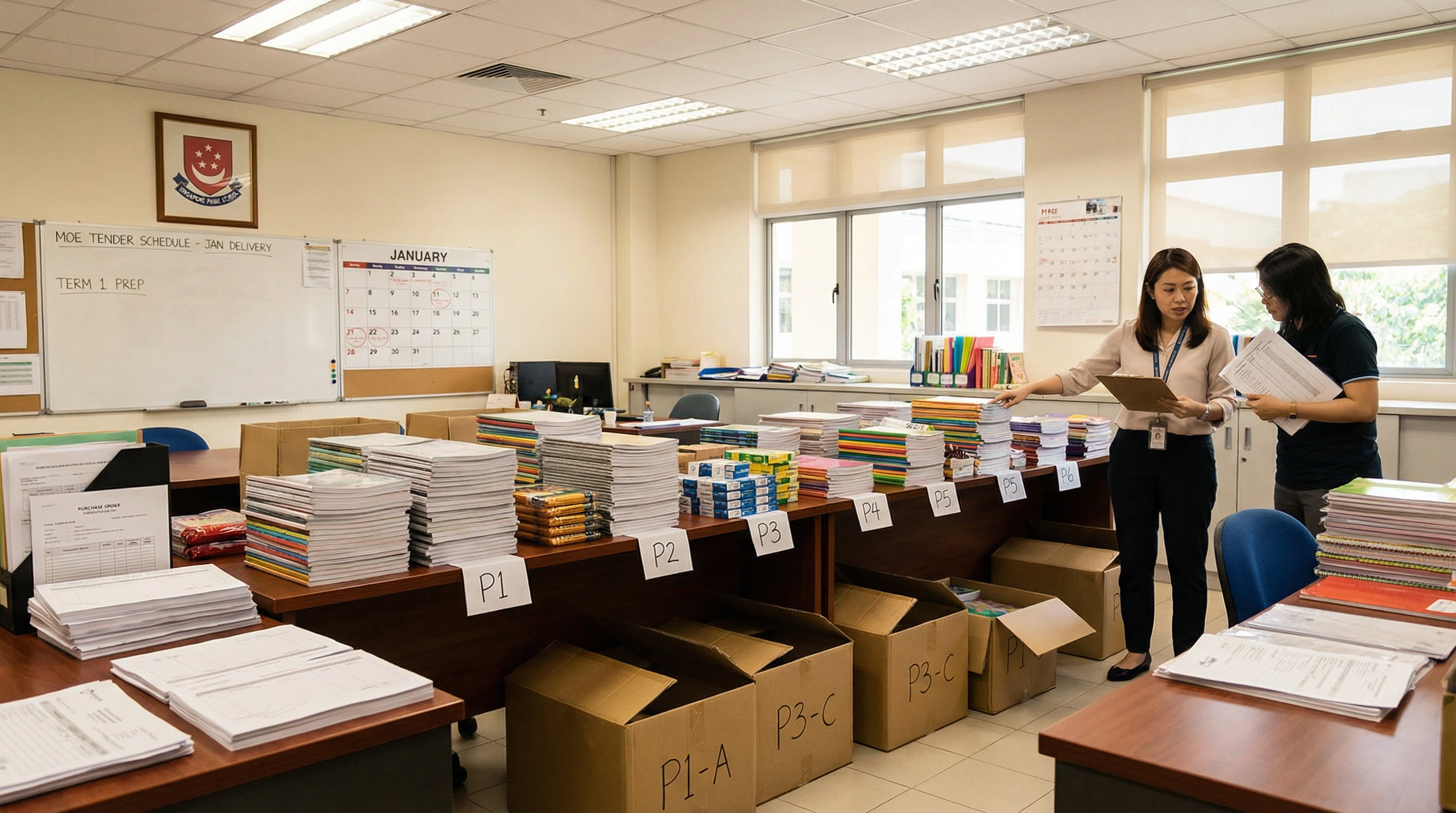
In October 2023, a stationery distributor new to Singapore's education market submitted a competitive quotation to a government primary school for 48,000 exercise books, expecting to win the business based on their 12% lower pricing versus incumbent suppliers. The school's procurement committee thanked them for the submission but explained they'd already finalized their stationery contracts for the 2024 academic year back in September, and wouldn't be reviewing new suppliers until Q4 2024 for the 2025 academic year. The distributor had missed the procurement window entirely—not because their pricing wasn't competitive, but because they didn't understand that Singapore schools operate on annual tender cycles that close 3-4 months before the academic year begins.
Singapore's education sector represents approximately 18-22% of the island's total office and stationery market by value (estimated at SGD 108-132 million annually based on the USD 601.7 million total Singapore office supplies market in 2024), but it operates on procurement rhythms completely different from corporate or retail channels. Success in this segment requires understanding three overlapping cycles: the Ministry of Education's centralized tender schedule for bulk commodities, individual schools' direct procurement timelines for specialized items, and the term-based demand patterns that create three distinct peaks in January, May/June, and August rather than the single September back-to-school surge common in Western markets.
MOE Centralized Procurement: Q4 Tenders for Next Academic Year
The Ministry of Education coordinates centralized procurement for common stationery items used across Singapore's 180+ government and government-aided primary schools, 150+ secondary schools, and 18 junior colleges. This centralized approach, managed through the GeBIZ government procurement portal, covers high-volume commodities where bulk purchasing generates significant cost savings: standard exercise books (ruled, squared, blank), writing paper, examination booklets, and basic writing instruments like 2B pencils for standardized testing.
MOE typically releases these tenders in October-November for contracts covering the following calendar year (which aligns with Singapore's academic year running January-December). For example, the tender for 2025 academic year stationery would be posted on GeBIZ in October-November 2024, with bid submission deadlines in late November or early December, contract awards in December, and delivery schedules beginning in January 2025. This timeline allows successful bidders approximately 4-6 weeks to prepare inventory and coordinate logistics before the January term start.
The tender specifications are highly standardized to enable competitive bidding and ensure consistent quality across schools. Exercise books must meet specific paper weight (typically 70-80 GSM), ruling specifications (8mm spacing for primary levels, 7mm for secondary), and binding requirements (saddle-stitch for thin books, perfect binding for thicker workbooks). 2B pencils must comply with ASTM D4236 non-toxicity standards and achieve specific hardness grades verified through standardized testing. Packaging must be in quantities convenient for school distribution—typically boxes of 100 or 500 units rather than retail-style individual packaging.
Pricing for MOE tenders is evaluated on a total-cost basis including delivery to individual school sites across Singapore. Unlike corporate tenders where delivery to a single central warehouse is common, education tenders require distribution to 180+ locations ranging from dense urban areas like Toa Payoh to outlying regions like Punggol or Jurong West. Suppliers must either maintain their own delivery fleet capable of island-wide coverage or partner with logistics providers who can handle multi-site distribution within tight timeframes (typically 3-5 working days from order to delivery during peak periods).
The volume commitments in MOE tenders are substantial but not guaranteed. A typical tender might specify an estimated annual requirement of 2.4 million exercise books, but this is a forecast rather than a firm commitment—actual orders depend on enrollment numbers and individual school requisitions throughout the year. Suppliers must balance the need to maintain sufficient inventory to meet demand spikes (particularly in December-January before the new academic year) against the risk of overproduction if actual orders fall short of estimates.
For new suppliers attempting to break into MOE tenders, the key challenge is demonstrating capability to meet delivery timelines and quality standards without an established track record in Singapore's education sector. MOE evaluation criteria typically weight technical compliance and delivery capability at 40-50% of the total score, with price accounting for the remaining 50-60%. A supplier offering 15% lower pricing but with no proven history of multi-site school deliveries in Singapore will often lose to an incumbent with 8% higher pricing but documented on-time delivery performance across 100+ school locations.
School Direct Procurement: Decentralized Buying for Specialized Needs
While MOE centralized tenders cover commodity items, individual schools retain autonomy to directly procure specialized stationery that varies by curriculum, teaching methods, or school-specific programs. This includes items like subject-specific workbooks, art supplies for specialized art programs, science laboratory notebooks with pre-printed data tables, and branded stationery featuring school crests or mottos.
School direct procurement follows a different timeline than MOE tenders, though it's still anchored to the academic year cycle. Most schools begin planning their specialized stationery needs in Q3 (July-September) of the preceding year, consulting with department heads to identify requirements for the upcoming academic year. Procurement committees then solicit quotations in September-October, evaluate submissions in October-November, and finalize contracts by November-December to ensure delivery before the January term start.
The decision-making process for school direct procurement is more relationship-driven than MOE tenders. While schools must still follow government procurement guidelines (particularly for purchases exceeding SGD 6,000, which require at least three competitive quotations), the evaluation criteria are less rigidly structured. Schools value suppliers who understand their specific needs, can accommodate mid-year adjustments to order quantities, and provide responsive customer service when urgent replacements are needed.
A practical example illustrates this dynamic. In August 2024, a secondary school's mathematics department requested specialized graph paper notebooks with 2mm grid spacing (versus the standard 5mm) for their advanced calculus classes. The school's existing stationery supplier, who had been serving them for six years, didn't stock this item but proactively sourced it from a specialized manufacturer, arranged sample approval within one week, and delivered the full order (2,400 notebooks) two weeks before the term start. A new supplier offering 10% lower pricing but requiring 4-week lead time and minimum order quantities of 5,000 units would have struggled to compete despite the price advantage.
School direct procurement also encompasses emergency and mid-term replenishment orders that don't follow the annual cycle. A school might exhaust their supply of examination booklets mid-year due to higher-than-expected enrollment or additional testing requirements. In these cases, procurement timelines compress dramatically—schools need delivery within 3-5 working days and will pay premium pricing to suppliers who can respond quickly. Suppliers who maintain buffer inventory of commonly-requested items and can offer same-day or next-day delivery for urgent orders build loyalty that translates into renewed annual contracts even if their baseline pricing isn't the lowest.
The total value of school direct procurement is difficult to estimate precisely (schools don't publicly report this data), but industry participants estimate it represents 30-40% of total education sector stationery spending—smaller than MOE centralized procurement in volume terms, but often higher-margin due to the specialized nature of the products and the premium placed on service and responsiveness.
Term-Based Demand Patterns: Three Annual Peaks Instead of One
Unlike Western markets where back-to-school demand concentrates in August-September, Singapore's academic calendar creates three distinct demand peaks aligned with term starts: January (Term 1), late May/early June (Term 3), and late August (Term 4). Understanding these peaks and the specific product mix demanded at each is critical for inventory planning and sales forecasting.
The January peak is the largest, accounting for approximately 45-50% of annual education stationery demand. This surge is driven by several factors: new students entering Primary 1, Secondary 1, or Junior College 1 who need complete stationery kits; all students moving up one grade level and requiring new textbooks, workbooks, and subject-specific materials; and schools replenishing their inventory after the December year-end depletion. Demand in January focuses heavily on exercise books, writing instruments, and basic supplies that students will use throughout the year.
Suppliers must pre-position inventory in November-December to meet January demand, as lead times from manufacturing (particularly for items sourced from regional suppliers in Malaysia, Indonesia, or China) can be 4-6 weeks. A distributor serving 20-30 schools might need to stock 180,000-220,000 exercise books, 45,000-60,000 pens and pencils, and 8,000-12,000 specialty items (graph paper, art supplies, science notebooks) in December to ensure they can fulfill January orders without stockouts. This inventory investment ties up working capital for 6-8 weeks, creating cash flow challenges for smaller distributors.
The May/June peak (coinciding with Term 3 start after the one-week mid-year school holiday in late May) is smaller, representing approximately 20-25% of annual demand. This peak is driven primarily by replenishment—students replacing depleted exercise books, worn-out pens, and lost or damaged items. The product mix shifts toward consumables (loose-leaf paper, refill pens, erasers) rather than the durable items (pencil cases, rulers, protractors) that dominate January sales. Schools also use this period to replenish inventory for the second half of the academic year, though their orders are typically 40-50% smaller than January.
The August peak (Term 4 start after the one-month June-July school holiday) shows similar patterns to May/June, accounting for 15-20% of annual demand. However, August also sees increased demand for examination-related stationery—examination booklets, answer sheets, and specialized stationery for national examinations (PSLE for Primary 6, O-Levels for Secondary 4, A-Levels for Junior College 2) that occur in September-November. Schools begin stockpiling these items in August to ensure adequate inventory for the examination period.
The remaining 10-15% of annual demand is distributed across the rest of the year as ad-hoc replenishment and emergency orders. These off-peak orders are valuable for suppliers because they typically carry higher margins (schools are less price-sensitive when ordering small quantities urgently) and help smooth cash flow between the major peaks.
For suppliers, managing these three peaks requires careful inventory planning and flexible logistics. A common strategy is to maintain 60-70% of peak inventory in-house (to ensure availability for core customers and urgent orders) while arranging backup supply agreements with regional partners who can provide 7-10 day replenishment for secondary items. This balances the need for responsiveness against the working capital cost of holding excessive inventory during off-peak months.
Practical Strategies for Education Sector Market Entry
Suppliers new to Singapore's education market should approach it as a multi-year relationship-building exercise rather than a transactional sales opportunity. The annual tender cycles and entrenched supplier relationships mean that winning significant market share requires sustained effort over 2-3 years, but the payoff is relatively stable, recurring revenue once relationships are established.
Start by targeting school direct procurement rather than MOE centralized tenders. Direct procurement offers lower barriers to entry (smaller order quantities, less emphasis on established track record) and allows you to demonstrate capability before competing for larger MOE contracts. Focus on specialized items where you can differentiate through product knowledge, customization capability, or superior service rather than competing purely on price for commodity items where incumbents have scale advantages.
Build relationships during off-peak periods (February-April, July-August) when school procurement staff have more time for supplier meetings and product demonstrations. Use these periods to understand each school's specific needs, curriculum requirements, and pain points with current suppliers. Offer to provide samples, conduct product trials, or sponsor small-scale pilot programs that demonstrate your capability without requiring schools to switch their entire supply base.
When bidding for annual contracts, emphasize service capabilities that matter to schools: responsive customer service, flexible order quantities, quick turnaround for urgent requests, and willingness to accommodate mid-year adjustments. Many schools will accept 5-8% higher pricing from a supplier who can deliver emergency orders within 24 hours versus a lower-priced supplier with rigid 2-week lead times.
Align your inventory and logistics planning with the three-peak demand pattern. Build inventory in November-December for January peak, April-May for May/June peak, and July for August peak. Maintain buffer stock of fast-moving items (standard exercise books, ballpoint pens, 2B pencils) year-round to capture emergency orders. Partner with logistics providers who can handle multi-site school deliveries efficiently—this capability is often more important than having the lowest product cost.
For MOE centralized tenders, consider partnering with established education suppliers as a subcontractor before bidding independently. This allows you to gain experience with MOE requirements, build delivery track record, and understand the evaluation criteria without bearing the full risk of a failed bid. After 1-2 years as a subcontractor, you'll be better positioned to bid independently with credible references and demonstrated capability.
Related Articles:
- Singapore Government Tender Requirements (GeBIZ): How to Win Office Supplies Contracts in Public Sector Procurement
- Singapore Jurong Industrial Estate Warehouse Logistics: Same-Day Delivery Challenges for B2B Stationery Distribution
- Singapore Retail vs B2B Stationery Pricing Structures: Why Corporate Buyers Pay 40-60% Less Than Consumers
Ready to enter Singapore's education stationery market with the right timing and strategy? Contact our Singapore sales team to discuss school procurement cycles and tender preparation, or request a quote for education-sector stationery programs aligned with MOE specifications.