Jurong Industrial Estate Bulk Delivery Logistics: How Warehouse Consolidation Affects Corporate Stationery Lead Times
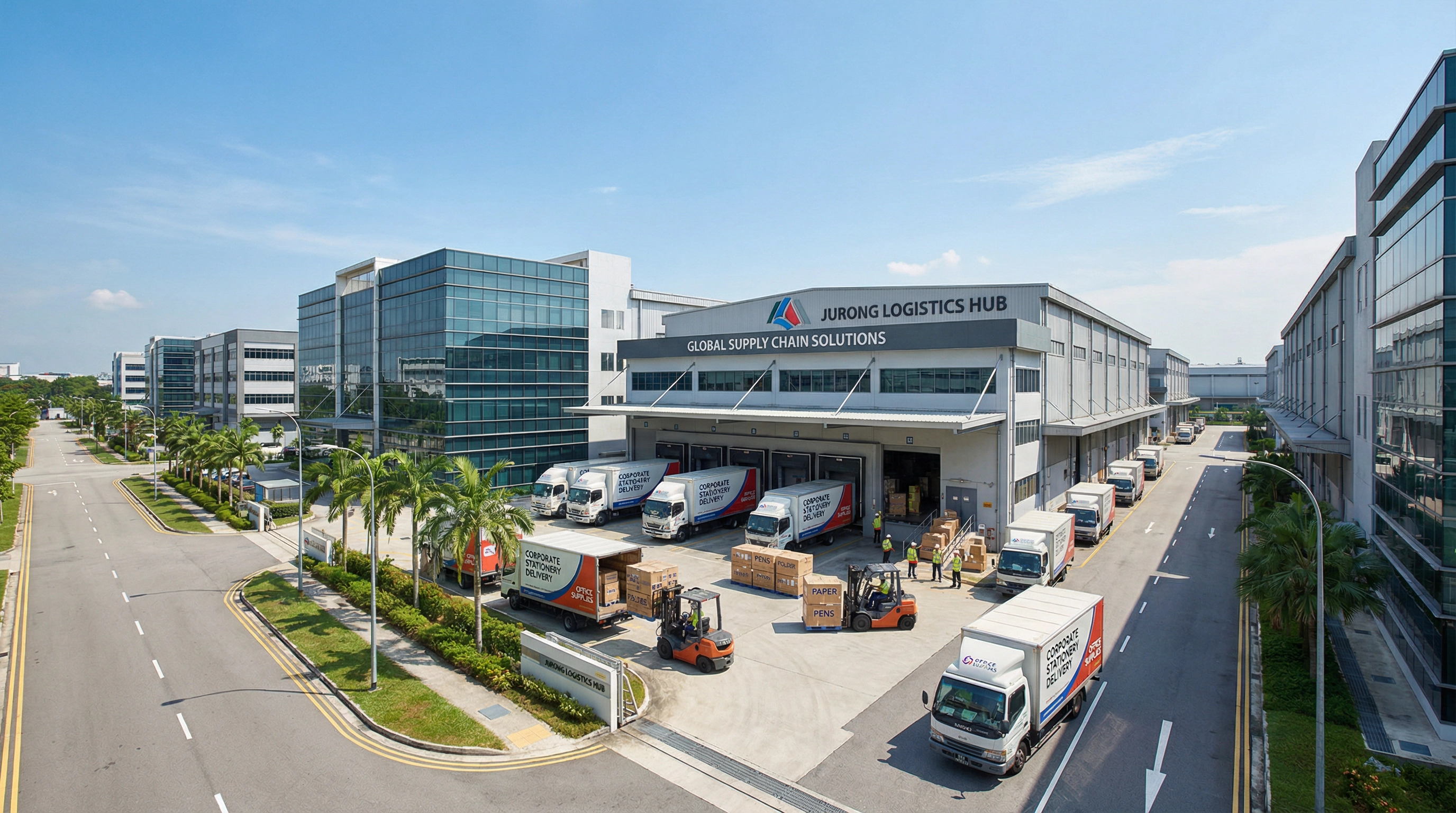
In October 2024, a Singapore-based regional distributor serving 180 corporate clients across the island consolidated their three warehouse locations (Jurong West, Woodlands, Changi) into a single 45,000 sq ft facility in Jurong Industrial Estate. The consolidation promised SGD 180,000 in annual rental savings and simplified inventory management. Four weeks after the move, their average delivery lead time had increased from 1.8 days to 3.2 days, and they'd received 23 customer complaints about delayed deliveries—more than the previous six months combined.
The problem wasn't operational incompetence. It was geography and Singapore's unique urban logistics constraints. Their previous three-warehouse model positioned inventory close to customer clusters: Jurong West served western Singapore clients (manufacturing, logistics companies), Woodlands served northern clients (tech parks, industrial facilities), and Changi served eastern and CBD clients (financial services, professional services). The consolidated Jurong location was optimal for western Singapore but added 45-60 minutes of travel time to reach CBD clients during peak traffic hours.
This case illustrates a fundamental tension in Singapore B2B logistics: warehouse consolidation reduces fixed costs but increases variable delivery costs and lead times. The optimal solution depends on customer distribution, order frequency, and service level requirements—variables that differ significantly between retail and corporate stationery procurement.
Why does Jurong Industrial Estate dominate Singapore's warehouse market?
Jurong Industrial Estate, developed since the 1960s as Singapore's primary manufacturing and logistics hub, houses approximately 40% of the island's warehouse capacity despite representing only 8% of total land area. This concentration reflects deliberate urban planning: the government designated Jurong for industrial use, offering lower land costs and streamlined permitting compared to mixed-use or residential zones.
For stationery distributors, Jurong offers three key advantages:
1. Rental Cost Differential As of Q4 2024, warehouse rental rates in Jurong Industrial Estate average SGD 1.80-2.40 per sq ft monthly, compared to SGD 3.20-4.50 per sq ft in Changi Business Park and SGD 4.80-6.20 per sq ft in locations near the CBD. For a 45,000 sq ft facility, this translates to:
- Jurong: SGD 81,000-108,000 monthly
- Changi: SGD 144,000-202,500 monthly
- Near-CBD: SGD 216,000-279,000 monthly
The annual savings from choosing Jurong over Changi: SGD 756,000-1.1M. This cost differential explains why 70% of Singapore's stationery distributors operate from Jurong or nearby Tuas despite serving clients island-wide.
2. Logistics Infrastructure Jurong benefits from direct access to major expressways (Ayer Rajah Expressway, Pan Island Expressway, Kranji Expressway) and proximity to PSA Singapore Terminals for import/export operations. The industrial estate's road network is designed for heavy vehicle traffic, with wider lanes, higher weight limits, and dedicated loading zones that aren't available in commercial or residential areas.
This infrastructure matters for stationery distribution because bulk orders (500+ reams of paper, palletized deliveries) require trucks that can't navigate narrow CBD streets or residential loading bays. A distributor serving both bulk clients (schools, government agencies) and small office clients (law firms, consultancies) needs warehouse locations that accommodate both 10-ton trucks (for bulk) and vans (for small orders).
3. Regulatory Simplicity Operating a warehouse in Jurong requires only standard industrial permits. Operating in mixed-use zones (like Changi Business Park) or near residential areas requires additional approvals for noise, operating hours, and vehicle movements. These regulatory constraints limit flexibility: a Jurong warehouse can operate 24/7 for receiving shipments, while a Changi facility might be restricted to 7am-7pm operations to avoid disturbing nearby offices.
However, Jurong's advantages come with a critical trade-off: distance from customers. The distributor's consolidation case demonstrates this trade-off quantitatively.
The Consolidation Case Study: Cost Savings vs Service Level Degradation
The distributor's three-warehouse network had operated since 2019:
Pre-Consolidation Network (2019-2024):
- Jurong West (18,000 sq ft): Served 65 clients in western Singapore, average delivery time 1.2 days
- Woodlands (12,000 sq ft): Served 42 clients in northern Singapore, average delivery time 1.6 days
- Changi (15,000 sq ft): Served 73 clients in eastern Singapore and CBD, average delivery time 2.1 days
- Total Rental Cost: SGD 42,000 monthly (Jurong: SGD 14,400, Woodlands: SGD 10,200, Changi: SGD 17,400)
- Total Operating Cost: SGD 78,000 monthly (rental + utilities + 6 warehouse staff)
Post-Consolidation Network (October 2024):
- Jurong Industrial Estate (45,000 sq ft): Serves all 180 clients island-wide
- Total Rental Cost: SGD 27,000 monthly (SGD 1.80 per sq ft × 45,000 sq ft)
- Total Operating Cost: SGD 52,000 monthly (rental + utilities + 4 warehouse staff)
- Monthly Savings: SGD 26,000 (33% reduction)
The financial case was compelling: SGD 312,000 annual savings with improved inventory visibility (single location vs three separate stocks). However, the service level impact was immediate and negative:
Delivery Performance Changes:
- Western Singapore clients: 1.2 days → 1.4 days (+17%)
- Northern Singapore clients: 1.6 days → 2.8 days (+75%)
- Eastern/CBD clients: 2.1 days → 3.2 days (+52%)
- Overall average: 1.8 days → 3.2 days (+78%)
The lead time degradation was most severe for northern and eastern clients because Jurong is geographically opposite from these areas. A delivery from Jurong to Woodlands requires 35-45 minutes of expressway driving during off-peak hours, extending to 60-75 minutes during morning (7-9am) or evening (5-7pm) peak periods. For CBD clients, the journey is 40-50 minutes off-peak, 70-90 minutes peak.
The distributor's delivery fleet (4 vans) could previously complete 3-4 deliveries per day from each warehouse (total: 9-12 deliveries daily across the network). From the single Jurong location, the same fleet could only complete 6-8 deliveries daily due to longer travel times. To maintain service levels, they needed to add 2 additional vans (SGD 4,800 monthly lease cost) and 2 drivers (SGD 9,000 monthly labor cost), reducing net savings from SGD 26,000 to SGD 12,200 monthly—a 53% erosion of the consolidation benefit.
Singapore's Traffic Patterns and Their Impact on B2B Delivery Windows
Singapore's road network operates near capacity during peak hours, with average speeds on major expressways dropping from 70-80 km/h (off-peak) to 30-45 km/h (peak). This congestion creates a time-of-day dependency for delivery planning that's unique to Singapore's compact geography.
A Jurong-to-CBD delivery scheduled for 8:30am arrival requires:
- Departure at 7:00am: 50-minute journey (pre-peak traffic)
- Departure at 7:30am: 75-minute journey (entering peak)
- Departure at 8:00am: 90-minute journey (full peak)
This 40-minute variance makes delivery scheduling unreliable. Corporate clients typically request delivery windows (e.g., "between 9-11am") that are difficult to guarantee from a single Jurong location serving island-wide clients.
The distributor's solution was to implement time-zone-based delivery scheduling:
Morning Deliveries (7-11am):
- Depart Jurong 6:30-7:30am for CBD/eastern clients (beat peak traffic)
- Depart Jurong 8:00-9:00am for western/northern clients (shorter distance, peak traffic less critical)
Afternoon Deliveries (2-5pm):
- Depart Jurong 12:30-1:30pm for all zones (post-lunch off-peak window)
Evening Deliveries (6-8pm):
- Depart Jurong 5:00-5:30pm for western clients only (short distance, can complete before 7pm despite peak traffic)
This scheduling optimization reduced average delivery time from 3.2 days to 2.4 days—still 33% slower than the pre-consolidation network, but acceptable to most clients. However, it required sophisticated route planning software (SGD 12,000 annual subscription) and eliminated the flexibility to accommodate same-day delivery requests, which had previously been possible for 40% of orders from the three-warehouse network.
Customer Segmentation: Which Clients Accept Longer Lead Times?
Not all corporate clients value delivery speed equally. The distributor's customer analysis revealed three segments with different service level requirements:
Segment 1: JIT Clients (28% of customers, 45% of revenue)
- Characteristics: Large offices (200+ employees), high consumption volume, limited storage space
- Typical order: 40-80 reams of paper, 200-400 pens, weekly frequency
- Service requirement: 24-48 hour delivery, narrow delivery windows (must arrive before stockroom closes at 5pm)
- Willingness to pay premium for speed: High (8-12% price premium acceptable)
- Geographic distribution: 75% in CBD/eastern Singapore
Segment 2: Planned Procurement Clients (52% of customers, 38% of revenue)
- Characteristics: Mid-sized offices (50-200 employees), moderate consumption, adequate storage
- Typical order: 15-30 reams of paper, 100-200 pens, bi-weekly to monthly frequency
- Service requirement: 3-5 day delivery, flexible windows
- Willingness to pay premium for speed: Low (prefer cost savings over speed)
- Geographic distribution: 60% in western/northern Singapore
Segment 3: Bulk Buyers (20% of customers, 17% of revenue)
- Characteristics: Schools, government agencies, large corporations with central procurement
- Typical order: 200+ reams of paper, 1000+ pens, quarterly frequency
- Service requirement: 5-10 day delivery, scheduled in advance
- Willingness to pay premium for speed: None (price-sensitive, lead time irrelevant)
- Geographic distribution: Evenly distributed island-wide
The consolidation's service level degradation primarily affected Segment 1 clients, 75% of whom were located in CBD/eastern Singapore—the zones with the longest delivery times from Jurong. The distributor lost 8 Segment 1 clients (representing SGD 240,000 annual revenue) in the first 3 months post-consolidation due to delivery delays.
The solution was to implement a hybrid model: maintain the consolidated Jurong warehouse for Segments 2 and 3, but establish a small forward-stocking location (3,000 sq ft) in Changi Business Park specifically for Segment 1 clients. This "micro-fulfillment center" stocked only fast-moving SKUs (top 40 items representing 80% of Segment 1 volume) and enabled next-day delivery to CBD/eastern clients.
The micro-fulfillment center cost SGD 10,500 monthly (rental + 1 staff) but retained the 8 at-risk clients and prevented further defections. Net consolidation savings: SGD 12,200 (from earlier calculation) - SGD 10,500 = SGD 1,700 monthly—a 93% erosion of the original SGD 26,000 savings target.
This outcome illustrates the hidden cost of warehouse consolidation: the rental savings are visible and quantifiable, but the service level degradation and customer defection risk are harder to predict until they occur.
Alternative Logistics Models: Third-Party Fulfillment and Cross-Docking
Several Singapore stationery distributors have adopted alternative logistics models that avoid the consolidation trade-off:
Model 1: Third-Party Fulfillment Centers Partner with 3PL providers (Ninja Van, Qxpress, J&T Express) who operate multiple fulfillment centers island-wide. The distributor stores inventory at the 3PL's facilities and pays per-transaction fees (SGD 3.50-5.80 per delivery) instead of fixed warehouse rental.
Advantages:
- No fixed rental cost (variable cost scales with volume)
- Geographic distribution (3PLs operate 5-8 locations island-wide)
- Scalability (can increase/decrease volume without lease commitments)
Disadvantages:
- Higher per-unit cost for high-volume distributors (break-even typically 800-1,200 deliveries monthly)
- Less control over inventory (3PL manages stock, distributor has visibility but not physical access)
- Service quality variability (3PL prioritizes their own clients, distributor is secondary)
A distributor handling 600 deliveries monthly would pay SGD 2,100-3,480 monthly to a 3PL (600 × SGD 3.50-5.80), compared to SGD 27,000 for a dedicated Jurong warehouse. However, a distributor handling 2,000 deliveries monthly would pay SGD 7,000-11,600 to a 3PL—making a dedicated warehouse more economical.
Model 2: Cross-Docking with Regional Hubs Maintain a central warehouse in Jurong for bulk storage, but operate 2-3 cross-dock facilities in high-density customer zones (CBD, Changi, Woodlands). Inventory is transferred from Jurong to cross-docks overnight, then delivered to customers the next day from the nearest cross-dock.
Advantages:
- Combines Jurong's low rental cost with distributed delivery proximity
- Faster delivery times (cross-docks are closer to customers)
- Lower inventory holding cost (cross-docks hold only 1-2 days of stock, not full inventory)
Disadvantages:
- Operational complexity (requires nightly transfers between Jurong and cross-docks)
- Higher transportation cost (internal transfers add SGD 8,000-12,000 monthly)
- Requires sophisticated inventory allocation algorithms (which SKUs to stock at which cross-dock)
A large distributor (3,000+ deliveries monthly) implemented this model in 2023 with a 40,000 sq ft Jurong warehouse and three 2,000 sq ft cross-docks (CBD, Changi, Woodlands). Total monthly cost: SGD 72,000 (Jurong rental: SGD 24,000, cross-dock rentals: SGD 36,000, transfer logistics: SGD 12,000). This was SGD 20,000 more expensive than a single consolidated warehouse but delivered service levels equivalent to the previous multi-warehouse network.
Regulatory Considerations: URA Zoning and HDB Loading Bay Restrictions
Singapore's Urban Redevelopment Authority (URA) zoning regulations restrict warehouse operations to designated industrial zones, limiting where distributors can establish facilities. Operating a warehouse in a commercial or residential zone without proper permits can result in SGD 50,000-200,000 fines and forced relocation.
This regulatory constraint is why Jurong, Tuas, and Woodlands dominate warehouse locations—these are the designated industrial zones with B1 (light industrial) and B2 (general industrial) zoning that permits warehouse operations. Changi Business Park has limited B1 zoning, allowing small-scale warehousing (under 5,000 sq ft) but restricting heavy vehicle access.
For corporate stationery delivery, URA zoning creates a secondary challenge: many CBD office buildings restrict loading bay access to specific hours (typically 7-10am and 4-7pm) to avoid disrupting tenant operations. A distributor delivering from Jurong must time their journey to arrive during these windows, which coincide with peak traffic hours—compounding the travel time challenge.
HDB (Housing Development Board) commercial complexes, which house many SME clients, have even stricter loading restrictions: deliveries are often limited to 7-9am only, and vehicles over 2.5 tons are prohibited. This forces distributors to use smaller vans for HDB deliveries, reducing load capacity and increasing delivery frequency.
A distributor serving 40 HDB-based clients found that Jurong consolidation increased their HDB delivery costs by 60% because they needed to make more frequent trips with smaller vehicles to comply with weight restrictions and time windows. They eventually established a partnership with a Woodlands-based logistics provider who handled HDB deliveries on their behalf, paying SGD 6.50 per delivery vs SGD 4.20 for self-delivery—a 55% cost increase that eroded consolidation savings.
Future Trends: Autonomous Delivery and Micro-Fulfillment
Singapore's government is piloting autonomous delivery vehicles in designated zones, with potential to transform last-mile logistics by 2026-2028. The Land Transport Authority's (LTA) autonomous vehicle trials include cargo delivery robots capable of carrying 50-100 kg loads over distances up to 15 km.
For stationery distribution, autonomous delivery could enable cost-effective micro-fulfillment: a distributor could operate a central Jurong warehouse with autonomous vehicles making overnight deliveries to micro-fulfillment lockers positioned in CBD, Changi, and Woodlands. Customers would collect orders from lockers (similar to parcel locker systems) or receive same-day delivery from the nearest locker.
This model's economics are compelling: autonomous vehicles cost SGD 0.80-1.20 per km to operate (vs SGD 2.50-3.50 per km for driver-operated vans), and micro-fulfillment lockers cost SGD 2,000-3,500 monthly to lease (vs SGD 8,000-12,000 for a staffed cross-dock facility). However, regulatory approval and customer acceptance remain uncertain—many corporate clients prefer human interaction for delivery (to verify quantities, handle returns, etc.) rather than self-service locker collection.
Related Articles: