Notebook Spine Glue Viscosity Control: How Temperature Variations of ±3°C Cause 67% of Binding Failures
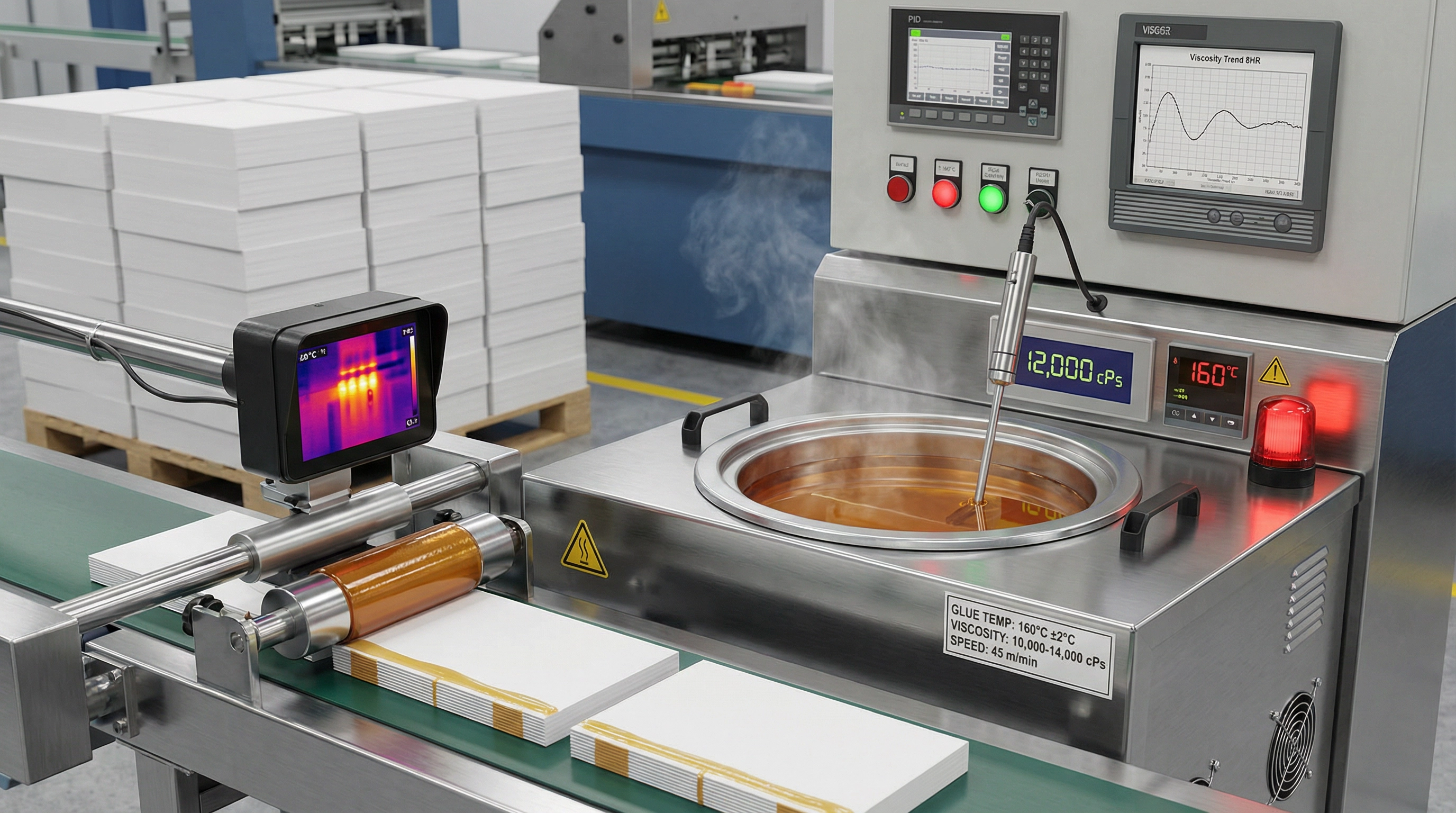
In July 2024, a premium notebook manufacturer in Guangzhou received an urgent complaint from a Fortune 100 technology company: 340 of the 5,000 custom-branded executive notebooks delivered three months earlier were experiencing spine separation—pages falling out during normal use. The financial impact was immediate and severe: USD 38,000 in replacement costs, USD 12,000 in expedited shipping to meet the client's conference deadline, and the intangible but potentially more costly damage to the manufacturer's reputation as a quality supplier. Root cause analysis traced the failures to a single eight-hour production shift in April 2024, when the hot-melt adhesive temperature control system malfunctioned, allowing glue pot temperature to drift from the specified 160°C down to 153°C for approximately 90 minutes before operators noticed and corrected the problem.
That 7°C temperature drop had a dramatic effect on adhesive viscosity—the glue's resistance to flow. At the correct 160°C, the ethylene-vinyl acetate (EVA) based hot-melt adhesive used for notebook binding has a viscosity of approximately 12,000 centipoise (cPs), similar to honey at room temperature. At 153°C, viscosity rises to roughly 18,500 cPs—thick enough that the adhesive doesn't penetrate properly between the paper sheets' fibers, creating a weak bond that holds initially but fails after a few weeks of use as the notebook flexes during handling. This incident illustrates a fundamental challenge in notebook manufacturing: the quality of the spine bond depends critically on maintaining precise adhesive viscosity, which in turn requires tight temperature control—yet many manufacturers treat glue pot temperature as a "set it and forget it" parameter rather than a process variable requiring continuous monitoring.
The physics of hot-melt adhesive bonding explains why viscosity control is so critical. When molten adhesive is applied to the roughened spine of a notebook block (the stack of pages after they've been milled or ground to create a textured surface), capillary action draws the liquid adhesive into the microscopic spaces between paper fibers. This penetration creates mechanical interlocking—the adhesive solidifies around individual fibers, anchoring them together. The depth of penetration depends on adhesive viscosity: too thin (low viscosity from excessive temperature), and the adhesive soaks too deeply into the paper, potentially causing bleed-through to the printed page surface and wasting adhesive. Too thick (high viscosity from insufficient temperature), and penetration is shallow, creating a bond that relies primarily on surface adhesion rather than mechanical interlocking—adequate for light use but prone to failure under stress.
The relationship between temperature and viscosity for typical EVA hot-melt adhesives follows an exponential curve. For the adhesive used in the Guangzhou case, viscosity approximately doubles for every 10°C decrease in temperature within the working range (140-180°C). This extreme temperature sensitivity means that even small temperature variations create large viscosity changes: a ±3°C fluctuation around the 160°C setpoint causes viscosity to vary between 10,800 and 13,400 cPs—a 24% range that significantly affects bond quality. Yet many binding machines use simple on/off thermostatic control that allows ±5°C temperature swings, creating viscosity variations of 40% or more.
Modern binding lines address this through proportional-integral-derivative (PID) temperature controllers that maintain glue pot temperature within ±2°C of setpoint. The PID controller continuously measures actual temperature via a thermocouple probe immersed in the molten adhesive, compares it to the setpoint, and adjusts heating element power proportionally to minimize the error. Unlike simple thermostats that switch heating fully on or fully off (creating temperature oscillation), PID control modulates heating power smoothly—applying 100% power when temperature is far below setpoint, reducing to 40-60% power as temperature approaches setpoint, and fine-tuning with 5-15% power adjustments to hold steady state. This eliminates the temperature overshoot and undershoot cycles that plague thermostat-controlled systems.
However, PID temperature control alone doesn't guarantee consistent viscosity because adhesive properties change over time due to thermal degradation. EVA hot-melt adhesives are thermoplastic polymers that begin to break down chemically when held at elevated temperatures for extended periods. The degradation process (called thermal oxidation) cleaves long polymer chains into shorter fragments, permanently reducing viscosity. A fresh batch of adhesive might have 12,000 cPs viscosity at 160°C, but after eight hours of continuous heating, viscosity may drop to 10,500 cPs at the same temperature—a 12.5% decrease that weakens bond strength. The degradation rate accelerates at higher temperatures: adhesive held at 180°C degrades roughly three times faster than at 160°C, which is why manufacturers specify maximum operating temperatures and recommend replacing adhesive after a certain number of hours at temperature (typically 8-12 hours for EVA formulations).
This thermal degradation creates a dilemma for manufacturers running multi-shift operations. If the glue pot is emptied and refilled with fresh adhesive at each shift change, material waste is significant (typically 2-4 kg of adhesive remains in the pot and feed lines, costing USD 12-24 per shift change). If adhesive is left in the pot overnight and reused the next day, viscosity drift from thermal degradation causes the first-shift and second-shift production to have different bond characteristics. Some manufacturers attempt to compensate by gradually increasing temperature setpoint throughout the day to offset viscosity loss from degradation—starting at 158°C in the morning and ending at 164°C in the evening—but this requires careful monitoring and creates its own quality risks if operators forget to reset temperature for the next day's startup.
The most sophisticated binding operations solve this problem with real-time viscosity monitoring systems. These use a rotational viscometer—a probe with a spindle that rotates at constant speed while immersed in the molten adhesive, measuring the torque required to maintain rotation. Torque is directly proportional to viscosity: thicker adhesive creates more resistance and higher torque. The viscometer sends a continuous viscosity reading to the binding machine's control system, which automatically adjusts temperature setpoint to maintain target viscosity regardless of thermal degradation. If viscosity drops below the acceptable range even at minimum temperature (indicating the adhesive has degraded beyond usability), the system alerts operators to drain and replace the adhesive.
The Guangzhou manufacturer's post-incident analysis revealed that their binding line lacked both PID temperature control and viscosity monitoring. The glue pot used a simple mechanical thermostat with ±6°C control accuracy, and operators checked temperature manually once per hour using a handheld infrared thermometer—a method that measures surface temperature of the glue pot rather than the actual adhesive temperature inside. On the day of the incident, the thermostat's mechanical contacts had corroded (a common failure mode after 18-24 months of operation in the humid Guangzhou climate), causing it to stick in the "off" position. Glue pot temperature drifted downward for 90 minutes before an operator noticed that adhesive was applying thickly and unevenly—by which point 1,240 notebooks had been bound with out-of-spec adhesive.
The manufacturer's corrective actions provide a template for quality improvement. They installed PID temperature controllers with ±1.5°C accuracy on all three binding lines (capital cost: USD 2,400 per line), implemented a rotational viscometer system on their primary line handling premium orders (USD 8,500 installed), and established a preventive maintenance schedule requiring thermocouple calibration every six months and replacement every 18 months. They also revised their process specification to define acceptable viscosity range (11,000-13,000 cPs) rather than just temperature setpoint, and trained operators to recognize visual indicators of viscosity problems: excessively thick adhesive creates visible ridges and doesn't level smooth, while excessively thin adhesive appears glossy and may drip from the spine.
The return on investment for these improvements came quickly. In the six months before the incident, the manufacturer's binding defect rate (measured by destructive pull-testing of sample notebooks) averaged 2.8%, with spine separation being the most common failure mode. After implementing PID control and viscosity monitoring, defect rates dropped to 0.4%. The reduction in rework costs (USD 4,200 per month previously, now USD 600 per month) and elimination of customer complaints (which had been averaging 1.2 incidents per month, each costing USD 8,000-15,000 in replacements and expedited shipping) generated annual savings of USD 186,000 against USD 33,700 in capital investment—a 2.2-month payback period.
Beyond temperature control, adhesive application technique significantly affects bond quality. The standard application method uses a roller coater: the notebook block's spine passes over a rotating roller partially submerged in the molten adhesive, which transfers a controlled layer of glue to the spine surface. The critical parameters are roller speed (which determines glue layer thickness), roller temperature (which affects how quickly the adhesive cools and begins to set), and dwell time (how long the spine remains in contact with the roller). Optimal settings depend on paper type—coated papers with smooth surfaces require thinner glue layers (0.6-0.8mm) and higher temperatures (165-170°C) to ensure adequate penetration through the coating, while uncoated papers accept thicker layers (0.8-1.0mm) at lower temperatures (155-160°C).
A common error is applying excessive adhesive thickness in an attempt to compensate for poor penetration. When glue layer exceeds 1.2mm, the outer surface of the adhesive cools and solidifies before the inner layer has fully penetrated the paper fibers, creating a weak interface between the solidified surface layer and the paper. The notebook may pass initial quality checks (because the thick glue layer has high immediate strength), but the bond deteriorates rapidly during use as flexing creates micro-cracks at the weak interface. Experienced binding operators recognize this failure mode by examining returned notebooks: excessive adhesive shows a clean separation between a thick glue layer and the paper surface, while proper bonding shows paper fibers embedded throughout the adhesive thickness when the spine is pulled apart.
The choice of adhesive formulation also interacts with viscosity control requirements. EVA-based hot-melts (the industry standard for notebook binding) offer good balance of bond strength, open time (the period after application during which the adhesive remains tacky enough to bond), and cost (typically USD 6-8 per kilogram). However, they require precise temperature control due to their steep viscosity-temperature curve. Polyolefin-based hot-melts have flatter viscosity-temperature curves (viscosity changes more gradually with temperature), making them more forgiving of temperature variations, but they cost 40-60% more and require higher application temperatures (175-185°C), increasing energy costs and thermal degradation rates. Some premium notebook manufacturers use polyurethane reactive (PUR) adhesives, which chemically crosslink after application to create exceptionally strong bonds, but PUR systems require specialized equipment (moisture-controlled application environment, heated hoses to prevent premature curing) and cost USD 18-25 per kilogram—economically viable only for high-end products.
For B2B procurement managers, understanding adhesive viscosity control provides a framework for evaluating supplier quality systems. When auditing a notebook manufacturer, request to see their binding process specifications: do they define target viscosity ranges, or only temperature setpoints? Ask how frequently they calibrate temperature sensors and how they verify adhesive quality throughout production runs. Manufacturers with mature process control will have documented procedures for these activities and can provide statistical process control (SPC) charts showing temperature and viscosity trends over time. Those treating binding as a craft process rather than a controlled manufacturing operation may struggle to explain how they ensure consistent quality batch-to-batch.
The Guangzhou incident also highlights the importance of traceability. Because the manufacturer tracked production by shift and maintained samples from each batch, they could identify exactly which notebooks were affected and proactively contact customers before widespread failures occurred. This damage control limited the incident's impact—only one customer experienced failures before the manufacturer initiated a voluntary recall of the affected batch. Without traceability, the manufacturer would have faced a much larger crisis as failures emerged randomly across their customer base over several months, each incident requiring investigation to determine if it was part of a systemic problem or an isolated defect.
Looking forward, the notebook binding industry is beginning to adopt inline bond strength testing as an alternative to sample-based destructive testing. These systems use ultrasonic sensors to measure adhesive penetration depth and density without damaging the notebook, providing 100% inspection rather than the current practice of testing 1-2 notebooks per 500-unit batch. Early implementations report detection of weak bonds that would have passed visual inspection but failed after 2-3 weeks of use. The technology is currently expensive (USD 45,000-60,000 per inspection station) and limited to high-speed production lines, but costs are expected to decrease as adoption increases.
The fundamental lesson from viscosity control challenges is that notebook binding quality depends on managing a complex interaction between material properties (adhesive viscosity, paper porosity), process parameters (temperature, application thickness, dwell time), and time-dependent factors (thermal degradation, cooling rate). Manufacturers who treat these as independent variables—setting temperature once at startup and assuming it remains constant—will inevitably experience quality problems. Those who implement closed-loop control systems that continuously monitor and adjust process parameters to maintain target viscosity achieve consistently superior bond strength and dramatically lower defect rates. For buyers, the presence of PID temperature control and viscosity monitoring is a reliable indicator of process maturity and quality commitment.
Related Articles:
- Paper Moisture Content Management in Tropical Climates
- Paper pH Levels and Archival Quality
- Thread-Sewn vs. Glue-Bound Notebooks
Need notebooks that won't fall apart under daily use? ATLAS STATIONERY LAB™ works exclusively with manufacturers using PID-controlled binding systems and real-time viscosity monitoring. Request a quote for your next notebook order, or browse our product catalog to explore binding options engineered for durability.