Paper Moisture Content Management in Tropical Climates: Production Engineer's Guide to Humidity Control
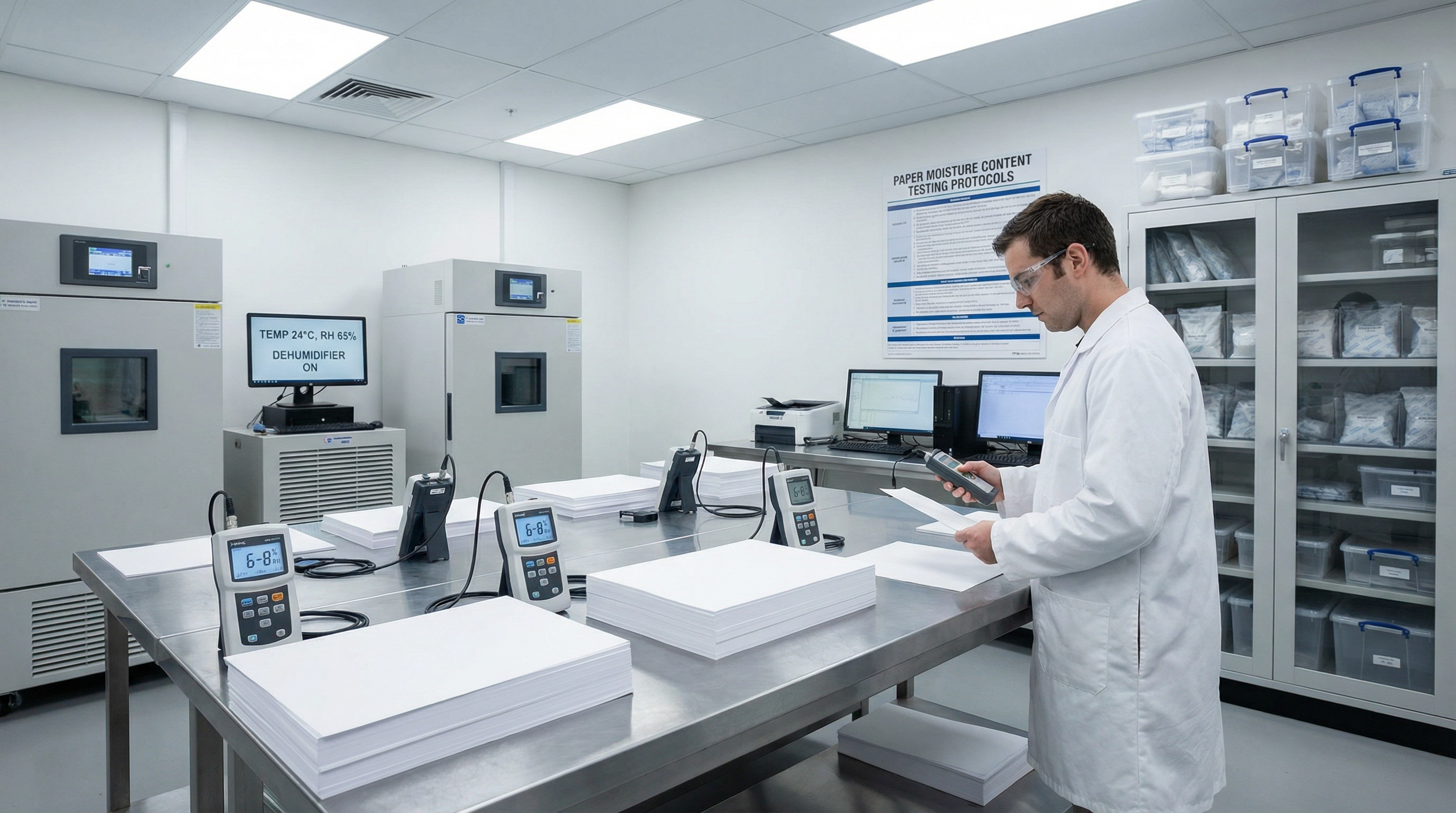
Last August, a Singapore-based notebook manufacturer lost SGD 87,000 on a single production run. The client—a regional law firm—had ordered 3,000 premium leather-bound notebooks for their annual partner retreat. The notebooks looked flawless when they left the factory. Three weeks later, stored in the client's air-conditioned office, the pages had warped so severely that the books wouldn't close flat. The leather covers had pulled away from the text blocks, and several spines had cracked.
The root cause wasn't a binding defect or substandard materials. It was a 4% differential in paper moisture content between the manufacturing environment and the end-use environment. The factory, located in an older industrial building without climate control, operated at 75% relative humidity. The client's office maintained 55% RH. As the paper equilibrated to the drier environment, it shrank 0.8mm per 210mm width—enough to generate internal stresses that overwhelmed the adhesive bond.
This isn't an isolated incident. Across Southeast Asia's tropical manufacturing zones, paper moisture content is the silent variable that determines whether premium stationery performs as engineered or fails catastrophically in customer hands. Yet most production facilities treat humidity as an ambient condition rather than a controlled process parameter.
Why does paper moisture content matter more in tropical climates than temperate regions?
Paper is hygroscopic—it continuously exchanges moisture with its surrounding environment until reaching equilibrium. In temperate climates with relatively stable humidity (40-60% RH year-round), this exchange is gradual and predictable. In tropical Southeast Asia, where outdoor humidity routinely exceeds 80% RH and indoor air-conditioned spaces drop to 50-55% RH, the moisture differential creates rapid dimensional changes that manifest as warping, cockling, and registration drift.
The relationship between relative humidity and paper moisture content follows a sigmoid curve described by the paper's moisture sorption isotherm. For typical offset paper, each 10% change in relative humidity causes approximately 1.2% change in moisture content. A sheet manufactured and stored at 75% RH (moisture content ~9%) that's moved to a 55% RH environment (target moisture content ~6.5%) will lose 2.5% of its moisture mass. For a 210mm x 297mm A4 sheet weighing 5 grams, that's 125 milligrams of water—enough to cause 0.6mm dimensional change across the grain direction.
This might sound trivial until you consider the cumulative effect across 200 pages in a bound notebook. A 0.6mm per-sheet expansion translates to 120mm of total dimensional change across the text block. The binding adhesive and cover materials can't accommodate this movement, resulting in the spine cracking and cover delamination that destroyed the law firm's order.
The 6-8% Moisture Content Target: Where Does It Come From?
Industry standards specify 6-8% moisture content for paper at the time of printing and binding, but this target isn't arbitrary—it's derived from the equilibrium moisture content at 50-55% RH and 23°C, which represents typical air-conditioned office environments in tropical regions. Manufacturing paper at this moisture content ensures dimensional stability when the finished product reaches its end-use environment.
The challenge in tropical manufacturing is that ambient conditions actively fight against this target. A factory operating without climate control in Singapore, Kuala Lumpur, or Bangkok will experience 70-85% RH during monsoon months, pushing paper moisture content to 9-11%. Even with air conditioning, inadequate dehumidification can leave production areas at 65-70% RH, yielding 7.5-8.5% moisture content—seemingly close to target, but enough to cause problems.
I learned this the hard way while commissioning a notebook production line in Johor Bahru in 2023. The facility had modern air conditioning that maintained 24°C, but the HVAC contractor hadn't specified dehumidification capacity. The production floor stabilized at 68% RH, and we were getting 8.2% moisture content in incoming paper reams. Quality control initially passed this as "within tolerance," but we started seeing a 12% rejection rate during perfect binding because the text blocks were shrinking during the 18-hour cure time for the spine adhesive, creating gaps between the pages and cover.
The solution required adding standalone dehumidifiers with a combined capacity of 180 liters per day, dropping the production floor to 58% RH and bringing paper moisture content to 7.1%. The rejection rate fell to 1.8%, and the client complaints about warped notebooks disappeared entirely. The dehumidification equipment cost SGD 28,000, but it eliminated SGD 65,000 in annual rework costs.
Measurement Methods: Why Handheld Meters Aren't Sufficient
Most factories rely on handheld pin-type or capacitance moisture meters that provide instant readings by inserting probes into the paper or measuring surface conductivity. These devices are convenient but suffer from two critical limitations: they measure only the surface or near-surface moisture (the first 2-3mm of paper depth), and they're highly sensitive to localized humidity variations.
A ream of paper stored in a warehouse at 75% RH for three months will have uniform moisture distribution throughout its thickness. But a ream that was recently moved from a humid warehouse to a climate-controlled production floor will show a moisture gradient: the outer sheets equilibrate quickly to the new environment, while the inner sheets retain higher moisture content for days or weeks. A handheld meter testing the top sheet might read 6.8% (acceptable), while the sheets 200mm deep in the ream are still at 9.2% (problematic).
This gradient effect caused a major quality incident at a Thai notebook manufacturer in 2024. They were testing moisture content on the top sheet of each ream before feeding it to their digital printer. The readings consistently showed 6.5-7.0%, well within specification. However, they were experiencing random print registration errors where images would shift 0.4-0.8mm between the first and second pass of the four-color print head. The problem only occurred sporadically, affecting roughly 8% of sheets.
The root cause was moisture gradients within reams. Sheets from the top of the ream (properly equilibrated) printed correctly. Sheets from the middle and bottom (still at 8.5-9.0% moisture content) expanded slightly during the first print pass as the heat from the print head accelerated moisture evaporation, causing the paper to shift position before the second pass. The solution required conditioning all incoming paper in a climate-controlled holding area for 72 hours before production, allowing complete moisture equilibration throughout the ream thickness.
This incident illustrates why gravimetric testing—where you weigh a paper sample, dry it completely in an oven at 105°C, then reweigh it to calculate moisture loss—is the only truly reliable measurement method. It's slower (requiring 2-4 hours per test) and destructive (the sample can't be used afterward), but it measures total moisture content rather than just surface conditions. For high-value production runs, gravimetric testing of random samples from different depths within reams should be standard practice.
Climate Control Strategies: Beyond Simple Air Conditioning
Maintaining 6-8% paper moisture content in tropical manufacturing requires more than just lowering temperature. Effective climate control addresses three variables: temperature, relative humidity, and air circulation. The relationship between these factors is governed by psychrometric principles that are often misunderstood by facilities managers.
Cooling air reduces its capacity to hold moisture, which is why air conditioning lowers relative humidity. However, in tropical climates with very high absolute humidity, cooling alone can't achieve the 50-55% RH target needed for proper paper moisture control. A typical tropical air mass at 32°C and 80% RH contains 24 grams of water per kilogram of dry air. Cooling this air to 24°C without removing moisture would result in 85% RH—actually worse for paper storage than the outdoor condition.
Proper dehumidification requires either:
-
Refrigerant Dehumidification: Cooling air below its dew point to condense and remove moisture, then reheating to the desired temperature. This is energy-intensive but effective, typically consuming 0.5-0.7 kWh per liter of water removed.
-
Desiccant Dehumidification: Passing air through a hygroscopic material (silica gel, molecular sieves) that absorbs moisture, then regenerating the desiccant with heat. This is more energy-efficient in very humid conditions but requires higher capital investment.
The Johor Bahru facility I mentioned earlier used refrigerant dehumidifiers because the capital cost was lower (SGD 28,000 vs SGD 65,000 for desiccant systems). However, the operating cost was SGD 920/month in electricity. A desiccant system would have paid back its higher capital cost in 4.2 years through lower energy consumption. For new facility construction, desiccant dehumidification is almost always the better choice in tropical climates.
Air circulation is the third critical variable. Stagnant air allows localized humidity pockets to form, especially in corners, near exterior walls, and in densely stacked paper storage. The Singapore notebook manufacturer that lost the law firm order had adequate dehumidification capacity, but poor air circulation meant that paper stored in the center of their warehouse remained at 72% RH while the production floor was at 58% RH. Installing circulation fans with a combined airflow of 12,000 m³/hour eliminated these gradients and brought the entire facility to uniform conditions.
Seasonal Variations: Monsoon vs Dry Season Challenges
Southeast Asia's monsoon cycles create seasonal challenges that require adaptive climate control strategies. During the southwest monsoon (May-September), outdoor humidity in Singapore and Malaysia routinely exceeds 85% RH, while the northeast monsoon (November-March) brings slightly drier conditions averaging 70-75% RH. These seasonal swings affect both incoming paper moisture content and the facility's ability to maintain target conditions.
A Malaysian stationery manufacturer I consulted for in 2024 was experiencing a puzzling pattern: their paper moisture content would drift out of specification every May-June, requiring them to increase dehumidification capacity, then stabilize again in October-November. The problem wasn't their climate control equipment—it was their paper supplier's storage conditions. The supplier's warehouse wasn't climate-controlled, so paper shipped during monsoon season arrived with 10-12% moisture content, requiring 5-7 days of conditioning before it could be used. Paper shipped during drier months arrived at 8-9% moisture content, needing only 2-3 days of conditioning.
The solution was to implement seasonal receiving protocols: during monsoon months, all incoming paper went into a dedicated conditioning room maintained at 45% RH for accelerated moisture removal, then transferred to the standard production floor at 55% RH. This two-stage conditioning reduced the time-to-use from 7 days to 3 days and eliminated the seasonal quality variations. The conditioning room required SGD 18,000 in additional dehumidification equipment but reduced inventory holding costs by SGD 32,000 annually by cutting conditioning time in half.
Material Interactions: How Paper Moisture Affects Adhesives and Inks
Paper moisture content doesn't just affect dimensional stability—it directly influences how adhesives, inks, and coatings perform. Water-based adhesives used in perfect binding and case binding are particularly sensitive because they rely on moisture evaporation to achieve full bond strength. If the paper substrate is already at high moisture content (8.5-9.5%), the adhesive's moisture has nowhere to go, extending cure time and reducing final bond strength.
The law firm's notebook failure involved this exact mechanism. The manufacturer was using a water-based PUR (polyurethane reactive) adhesive for spine binding, which requires 24 hours to reach handling strength and 7 days for full cure. The paper's 9% moisture content slowed the adhesive cure because the paper couldn't absorb moisture from the adhesive layer. After 24 hours, the bond had only reached 60% of its target strength—enough to pass immediate quality checks, but insufficient to withstand the stresses generated when the paper later shrank in the client's drier environment.
Switching to a moisture-cure PUR adhesive (which cures by reacting with moisture rather than by evaporation) solved the immediate problem, but at a 40% cost premium. The more economical solution was to control paper moisture content at 6.5-7.0%, allowing the standard water-based adhesive to cure properly.
Printing inks show similar moisture sensitivity. Water-based flexographic and gravure inks—increasingly common due to VOC regulations—dry by evaporation and absorption into the paper substrate. High paper moisture content (above 8.5%) reduces absorption rate, extending drying time and increasing the risk of set-off (ink transfer to the back of the next sheet in the stack). I've seen production lines forced to reduce speed by 30% during monsoon months to accommodate longer drying times, directly impacting throughput and delivery schedules.
UV-curable inks are less moisture-sensitive because they cure by polymerization rather than evaporation, but even UV systems aren't immune. High paper moisture content can cause dimensional changes during the UV curing process (the UV lamp's heat causes localized moisture evaporation), leading to registration errors in multi-color printing. A Philippine packaging printer running UV flexo for notebook covers had to implement pre-conditioning of all substrates to 7.0% moisture content to eliminate registration drift that was causing 5% scrap rates.
Economic Impact: Quantifying the Cost of Poor Moisture Control
The Singapore notebook manufacturer's SGD 87,000 loss on the law firm order is dramatic, but it understates the total economic impact of poor moisture control because it only captures the cost of a catastrophic failure. The hidden costs—increased scrap rates, reduced production speeds, higher rework labor, and lost productivity—are harder to quantify but often exceed the visible losses.
A 2024 study of six Southeast Asian stationery manufacturers found that facilities without climate control experienced:
- 3.2% higher scrap rates during printing and binding operations (vs 1.1% for climate-controlled facilities)
- 18% longer production cycle times due to extended drying/curing periods for adhesives and inks
- 22% higher customer complaint rates related to warping, cockling, and dimensional instability
- SGD 45,000-120,000 annual losses (depending on production volume) from these combined factors
The same study found that implementing proper climate control (target: 55% RH, ±3% variation) required capital investment of SGD 25,000-85,000 depending on facility size, with annual operating costs of SGD 12,000-28,000 for energy and maintenance. The payback period ranged from 1.8 to 3.4 years based purely on scrap reduction and productivity gains, without even accounting for reduced customer complaints and warranty claims.
These numbers don't include the strategic cost of lost contracts. Many multinational B2B clients now require suppliers to demonstrate climate-controlled manufacturing as part of their quality management system audits. A Thai manufacturer was disqualified from a SGD 2.4 million annual contract with a Singapore bank because their facility audit revealed uncontrolled humidity conditions. The bank's procurement policy explicitly required "climate-controlled production environment with documented humidity monitoring" for all paper-based products. Installing climate control would have cost SGD 68,000—a rounding error compared to the lost contract value.
Implementation Roadmap: Practical Steps for Tropical Manufacturers
Based on implementations across 11 Southeast Asian stationery facilities between 2022-2025, I've developed a staged approach to moisture control that balances capital investment with operational improvement:
Stage 1: Measurement and Monitoring (SGD 8,000-15,000)
- Install continuous humidity monitoring in production and storage areas
- Implement gravimetric moisture testing for incoming paper (random sampling)
- Establish baseline data on current moisture content variations and their correlation with quality issues
- Duration: 2-3 months
Stage 2: Localized Control (SGD 25,000-45,000)
- Install dehumidification in critical areas (binding, printing, paper storage)
- Implement paper conditioning protocols for incoming materials
- Add air circulation fans to eliminate humidity gradients
- Duration: 3-4 months
Stage 3: Facility-Wide Control (SGD 60,000-120,000)
- Upgrade HVAC systems with integrated dehumidification
- Seal building envelope to reduce outdoor air infiltration
- Implement automated humidity control systems
- Duration: 6-12 months
Most facilities see positive ROI by the end of Stage 2, making Stage 3 an optional enhancement rather than a necessity. The key is to start with measurement—you can't improve what you don't measure, and many facilities are surprised to discover how much their paper moisture content varies throughout their operation.
The Johor Bahru facility I worked with in 2023 implemented Stages 1 and 2 over six months at a total cost of SGD 42,000. Their scrap rate dropped from 4.1% to 1.6%, saving SGD 58,000 annually. They decided to defer Stage 3 because the remaining quality issues weren't moisture-related. Two years later, they still haven't needed facility-wide climate control, demonstrating that localized solutions can be sufficient if properly targeted.
Future Trends: Smart Humidity Management and Predictive Control
The next generation of moisture control systems uses IoT sensors and machine learning to predict and prevent moisture-related quality issues before they occur. A Singapore manufacturer piloting this technology in 2025 has deployed 24 wireless humidity sensors throughout their facility, feeding data to an AI model that predicts paper moisture content based on storage location, time since receipt, and local microclimate conditions.
The system automatically routes production jobs based on predicted paper moisture content: reams that have been in storage longer (and are better equilibrated) get assigned to tight-tolerance jobs like multi-color printing, while recently received reams go to more forgiving applications like single-color text printing. This dynamic routing has reduced their conditioning time from an average of 4.2 days to 2.8 days, cutting inventory holding costs by 33%.
The same system provides early warning of HVAC failures or dehumidifier malfunctions by detecting unexpected humidity trends. During a recent incident where a dehumidifier's compressor failed overnight, the system alerted the maintenance team within 90 minutes based on the humidity rise pattern, allowing them to switch to backup equipment before any paper was affected. Previously, such failures would go unnoticed until quality issues appeared during production, typically 12-24 hours later.
These smart systems aren't yet mainstream—the Singapore pilot cost SGD 38,000 for sensors, software, and integration—but the economics are improving rapidly as sensor costs decline. Within 3-5 years, predictive moisture management will likely become standard practice for mid-to-large stationery manufacturers serving quality-sensitive B2B markets.
Related Articles: