Automated Optical Inspection for Pen Assembly Quality Control: Machine Vision Systems Detecting 0.05mm Defects
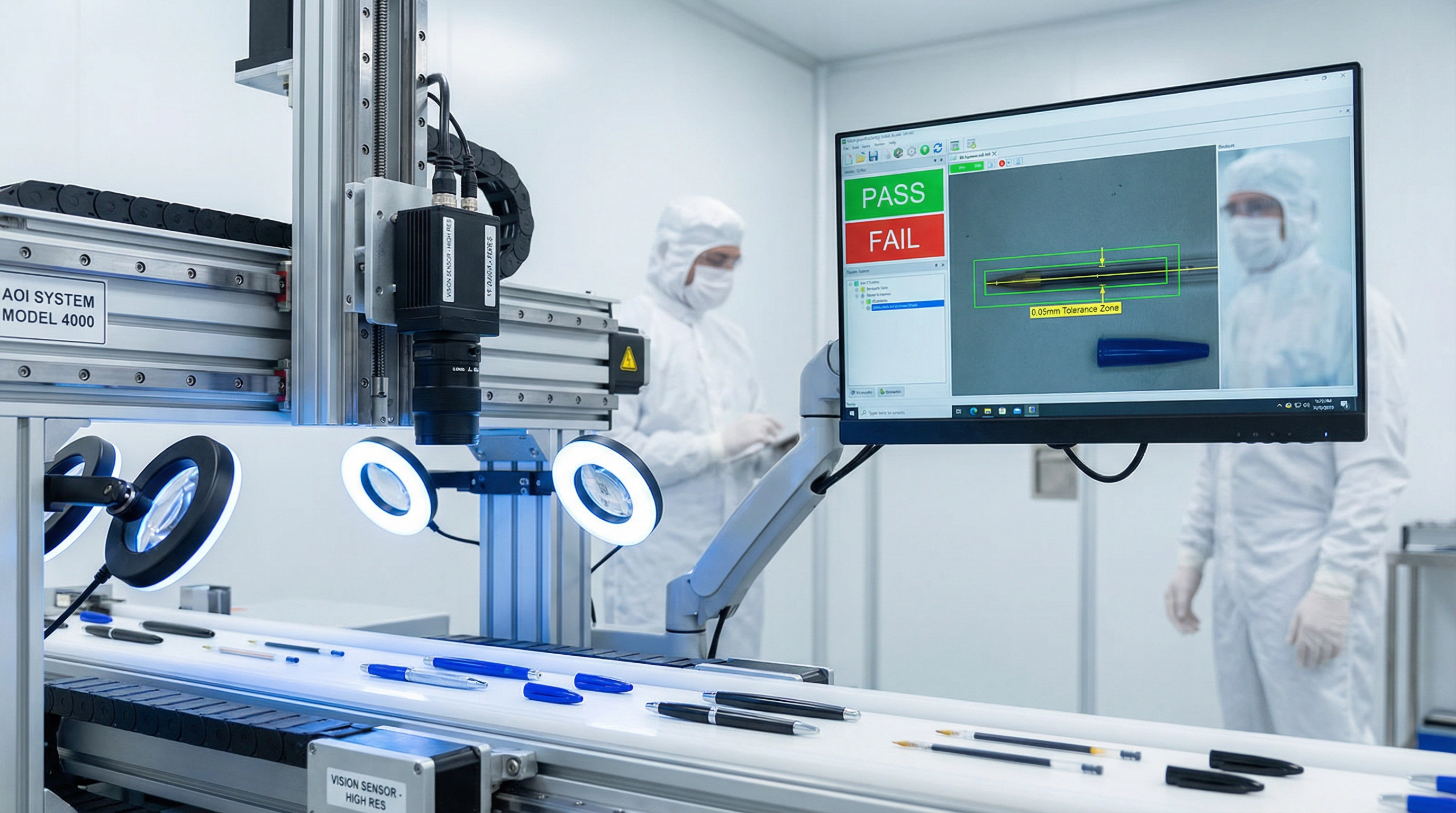
In March 2024, a mid-sized corporate stationery manufacturer in Dongguan faced a crisis when a Fortune 500 client rejected an entire shipment of 500,000 promotional ballpoint pens due to inconsistent clip alignment—defects measuring less than 0.08mm that human inspectors had missed during final QC. The rejection cost USD 47,000 in rework and delayed delivery by three weeks, jeopardizing a five-year supply contract. This incident pushed the manufacturer to invest in an automated optical inspection (AOI) system, which within six months reduced their defect escape rate from 1.2% to 0.03% while cutting inspection labor costs by 60%.
Automated optical inspection represents a fundamental shift in how precision assembly defects are caught before they reach customers. Unlike manual inspection, where fatigue and subjective judgment create variability, AOI systems use high-resolution cameras and machine vision algorithms to detect microscopic flaws with repeatable accuracy. For corporate stationery manufacturers competing on quality consistency rather than just price, understanding how these systems work—and where they still fall short—determines whether you can meet the tightening tolerances demanded by multinational buyers.
Machine Vision Fundamentals: How Cameras See What Humans Cannot
The core of any AOI system is its imaging hardware, typically consisting of a high-resolution industrial camera (5-12 megapixels), specialized lighting (coaxial, ring, or dome LEDs), and precision optics that can resolve features down to 0.01mm. For ballpoint pen assembly, the system scans each completed unit as it passes through the production line at speeds of 120-180 units per minute, capturing multiple images from different angles to build a complete dimensional profile.
What makes machine vision superior to human inspection isn't just magnification—it's consistency. A trained QC inspector can reliably detect defects larger than 0.15mm under good lighting conditions, but performance degrades after 45-60 minutes of continuous inspection due to visual fatigue. An AOI system maintains the same detection threshold throughout a 24-hour production run, and can be programmed to measure dimensional tolerances that would be impossible for human eyes to assess reliably, such as the 0.05mm gap specification between a pen clip and barrel.
The imaging process begins with proper illumination. Coaxial lighting (where light travels through the same optical path as the camera) excels at detecting surface scratches and printing defects on glossy pen barrels, while low-angle ring lighting creates shadows that make dimensional variations—like misaligned clips or uneven tip protrusion—stand out clearly. Many modern AOI systems use multi-spectral imaging, combining visible light with near-infrared wavelengths to detect subsurface defects like internal cracks in transparent plastic components that would be invisible under standard lighting.
Once images are captured, the system's software compares them against a "golden sample" reference model. This comparison isn't a simple pixel-by-pixel match (which would flag every minor variation as a defect) but rather an analysis of specific features: clip position relative to barrel centerline, ink cartridge insertion depth, tip concentricity, and print registration. The software measures these features and applies pass/fail criteria based on tolerances programmed during system setup—typically ±0.05mm for critical dimensions like clip alignment and ±0.02mm for tip concentricity on precision writing instruments.
False Positive Reduction Through AI Training: Teaching Machines What Matters
The Achilles' heel of early AOI systems was their tendency to generate false positives—flagging acceptable parts as defective due to harmless variations in lighting, part orientation, or surface texture. In the Dongguan manufacturer's case, their initial AOI deployment in April 2024 had a false positive rate of 18%, meaning nearly one in five pens flagged for rejection was actually within specification. This created a secondary inspection bottleneck as operators manually reviewed flagged parts, negating much of the automation benefit.
Modern AOI systems address this through machine learning algorithms that improve discrimination between true defects and acceptable variation. Rather than relying solely on fixed threshold values (e.g., "reject if clip angle exceeds 0.5 degrees"), AI-trained systems learn from thousands of labeled examples—both defective and acceptable parts—to develop more nuanced decision boundaries. This training process typically requires 2,000-5,000 sample images per defect type, with each image manually classified by experienced QC personnel as either "pass" or "fail."
The training dataset must include edge cases that confuse simpler algorithms: pens with minor cosmetic blemishes that don't affect function, acceptable variations in injection-molded clip geometry, and lighting artifacts that resemble defects. During training, the AI model adjusts its internal parameters to minimize classification errors, gradually learning which visual patterns correlate with actual functional defects versus harmless cosmetic variations. After six weeks of training on 8,400 labeled images, the Dongguan manufacturer reduced their false positive rate from 18% to 2.3%, making automated inspection practical for high-volume production.
However, AI training introduces new challenges. The model's performance is only as good as the training data—if the dataset doesn't include examples of a new defect type (say, a supplier changes clip material and introduces a new failure mode), the system won't recognize it until retrained. This creates an ongoing maintenance burden: quality engineers must continuously collect and label new defect examples, retrain the model quarterly, and validate performance against fresh test samples. One mid-sized pen manufacturer reported spending 40 hours per quarter on model maintenance, though this investment paid off through sustained 0.04% defect escape rates.
Another limitation is explainability. When an AI model rejects a part, it can be difficult to understand exactly why—the decision emerges from complex interactions among thousands of learned parameters rather than a simple "measurement X exceeded threshold Y" rule. This opacity frustrates operators who need to diagnose root causes and adjust upstream processes. Some newer AOI systems address this with attention mapping visualizations that highlight which image regions most influenced the reject decision, giving operators clues about whether the issue is clip misalignment, surface contamination, or another factor.
Integration with Manufacturing Execution Systems: Closing the Feedback Loop
An AOI system's value multiplies when it's integrated with the broader manufacturing execution system (MES) rather than operating as a standalone inspection station. Real-time data exchange between AOI and MES enables three critical capabilities: automated process adjustments, traceability for defect root cause analysis, and predictive maintenance alerts based on quality trends.
In the most sophisticated implementations, the AOI system doesn't just reject defective parts—it analyzes defect patterns and automatically adjusts upstream process parameters to prevent future defects. For example, if the system detects a gradual increase in clip misalignment over a two-hour period (suggesting tool wear in the clip insertion station), it can send a signal to the MES to either adjust insertion force parameters or trigger a tool change before defect rates exceed acceptable limits. This closed-loop control reduces scrap rates by catching process drift before it produces significant quantities of defective parts.
Traceability integration allows every inspected pen to be linked with its production history: which injection molding cavity produced the barrel, which assembly operator installed the clip, what batch of ink cartridges was used, and even ambient temperature and humidity during assembly. When a defect is detected, quality engineers can query the MES database to identify common factors among defective units—perhaps all rejected pens came from mold cavity #7, suggesting a worn core pin that needs replacement. This diagnostic capability, which would be nearly impossible with manual inspection records, enables faster root cause analysis and more targeted corrective actions.
The Dongguan manufacturer's MES integration revealed an unexpected correlation: pens assembled during the first 30 minutes after lunch breaks had 3.2x higher clip misalignment rates than those assembled at other times. Investigation showed that operators were rushing to meet hourly quotas after breaks, causing them to skip a critical barrel orientation check before clip insertion. The solution—adjusting quota timing to eliminate the post-break rush—was only possible because AOI data was timestamped and linked to operator shift schedules in the MES.
Predictive maintenance represents another integration benefit. By tracking inspection data over time, the system can detect gradual degradation in assembly quality that precedes equipment failure. A slow increase in tip concentricity variation might indicate bearing wear in the tip insertion press, while a rising trend in surface scratch defects could signal contamination in the barrel molding process. Rather than waiting for catastrophic failure or relying on fixed maintenance schedules, the MES can trigger condition-based maintenance when quality trends indicate impending problems—typically 1-2 weeks before defect rates would exceed acceptable limits.
However, MES integration isn't trivial. It requires compatible communication protocols (OPC-UA is becoming the industrial standard), synchronized data timestamps across multiple systems, and careful database design to handle the volume of inspection data generated—a single AOI station inspecting 150 pens per minute generates approximately 12,000 inspection records per eight-hour shift. The Dongguan manufacturer invested USD 28,000 in MES software upgrades and three weeks of systems integration work to achieve full AOI connectivity, though they recouped this cost within seven months through reduced scrap and rework.
Practical Limitations and Hybrid Inspection Strategies
Despite their capabilities, AOI systems cannot replace human judgment entirely. Certain defect types remain difficult for machine vision to detect reliably: subtle color variations in printed logos, tactile defects like rough surface texture, and functional issues like inconsistent ink flow that only manifest during actual writing. A complete quality strategy combines automated inspection for dimensional and visual defects with targeted manual inspection for characteristics that machines struggle to assess.
The most effective approach uses AOI as a first-stage filter that catches 95%+ of defects, followed by human inspection of flagged parts and periodic sampling of passed parts to validate system performance. In the Dongguan manufacturer's workflow, AOI inspects 100% of production at line speed, automatically rejecting obvious defects. Flagged parts go to a human inspector who makes the final pass/fail decision and provides feedback to retrain the AI model. Additionally, operators randomly sample 50 passed pens per shift for manual verification, checking for defect types the AOI might miss.
This hybrid strategy caught a critical issue in August 2024 that pure AOI would have missed: a batch of ink cartridges with correct dimensions but inconsistent flow rates due to a supplier's formulation change. The AOI system passed these pens because all dimensional checks were within tolerance, but manual sampling revealed that 8% wrote with intermittent skipping. The manufacturer quarantined the affected batch and implemented a new incoming inspection protocol for ink cartridges, preventing a potential customer complaint.
Cost considerations also limit AOI adoption, particularly for smaller manufacturers or low-volume specialty products. A complete AOI system with AI capabilities, MES integration, and multi-angle imaging costs USD 80,000-150,000 depending on configuration, plus ongoing expenses for model training, software updates, and maintenance. For a manufacturer producing 50,000 pens per day with a 1.5% defect rate, the system pays for itself within 12-18 months through reduced scrap and rework. But for a specialty pen maker producing 5,000 units per day of highly customized designs, the economics are less compelling—manual inspection may remain more cost-effective despite its limitations.
Setup complexity presents another barrier. Configuring an AOI system for a new pen design requires creating reference models, defining inspection zones, setting tolerance thresholds, and collecting training data—a process that can take 40-80 hours per product variant. Manufacturers with frequent design changes or high product mix may find this setup burden prohibitive. Some newer AOI systems offer "teach by example" modes that simplify setup, but these still require significant engineering time to validate performance before production use.
Future Directions: 3D Imaging and Collaborative Robots
The next generation of AOI technology is moving beyond 2D imaging toward full 3D reconstruction of inspected parts. Structured light scanning and stereo vision systems can capture complete dimensional profiles, detecting defects like warped barrels or uneven clip spring tension that are invisible in 2D images. While current 3D AOI systems are too slow for inline inspection of high-speed pen assembly (typical scan time is 3-5 seconds per part versus 0.4 seconds for 2D imaging), they're valuable for first-article inspection and periodic validation sampling.
Another emerging trend is integration with collaborative robots (cobots) that can automatically remove rejected parts from the production line and sort them by defect type for root cause analysis. Rather than simply ejecting defects into a scrap bin, the cobot places clip-misaligned pens in one container, surface-scratched pens in another, and print-defective pens in a third—enabling quality engineers to quickly assess which process stations need attention. This automated defect sorting, combined with MES data linking each part to its production history, accelerates continuous improvement cycles.
For corporate stationery buyers evaluating suppliers, asking about AOI capabilities provides insight into a manufacturer's quality maturity. Suppliers who have invested in modern AOI systems with AI training and MES integration demonstrate commitment to consistent quality and data-driven process control—capabilities that become critical when you're ordering 500,000 branded pens and cannot afford a single defective unit reaching your executive team. The technology isn't perfect, and it doesn't eliminate the need for skilled quality personnel, but it represents the current state of the art in catching microscopic defects before they become expensive customer complaints.
Related Articles:
- Heat Transfer vs Screen Printing Adhesion: Material Durability Testing for Corporate Pen Branding
- Injection Molding Pen Component Tolerances: Multi-Cavity Mold Precision Requirements
- UV-Curing vs Solvent-Based Ink Drying Systems: Energy Efficiency and Print Quality Trade-offs
Ready to ensure your corporate stationery meets the highest quality standards? Contact our quality systems team to discuss how advanced inspection technologies can guarantee defect-free delivery for your branded pen programs, or request a quote for precision-manufactured corporate stationery with documented quality control.