Singapore Green Mark Sustainability Reporting: How Stationery Procurement Affects BCA Certification Points
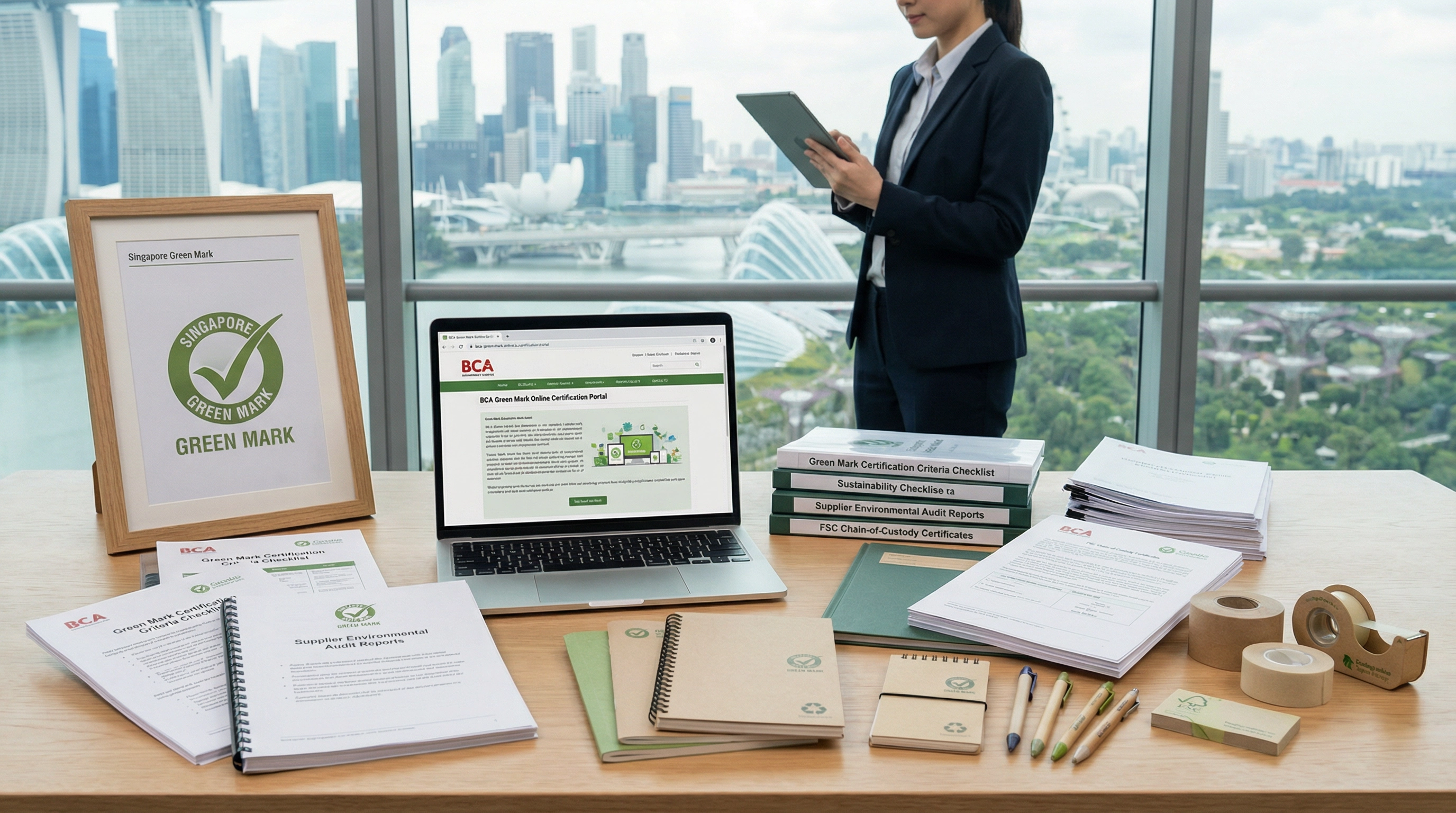
In August 2024, a Singapore-based regional headquarters of a European financial services firm discovered that their stationery procurement practices were jeopardizing their Building and Construction Authority (BCA) Green Mark Platinum certification renewal. During the routine sustainability audit required for recertification, the BCA assessor noted that while the company had implemented comprehensive energy efficiency and waste management programs, their office supplies procurement lacked documented environmental criteria and supplier verification—costing them 4 points in the Green Mark scoring system. Those 4 points represented the difference between maintaining Platinum status (requiring 90+ points) and dropping to Gold Plus (85-89 points), a downgrade that would affect the company's corporate sustainability reporting, potentially impact their ability to attract environmentally conscious tenants for sublease space, and contradict their public commitments to environmental leadership.
The financial impact of losing Platinum status extended beyond reputation. Singapore's Green Mark Incentive Scheme for Existing Buildings (GMIS-EB) provides cash incentives of up to SGD 3 million for achieving Platinum certification, with the exact amount based on building size and improvement measures implemented. The firm had received SGD 420,000 under GMIS-EB for their previous certification cycle, and dropping to Gold Plus would reduce their next-cycle incentive to approximately SGD 280,000—a SGD 140,000 financial penalty for inadequate stationery procurement documentation. This incident illustrates an often-overlooked aspect of Singapore's green building framework: seemingly minor operational details like office supplies purchasing can materially affect certification outcomes and associated financial benefits.
Singapore's Green Mark scheme, administered by BCA since 2005, evaluates buildings across five categories: energy efficiency, water efficiency, environmental protection, indoor environmental quality, and other green features and innovation. The "environmental protection" category includes a sub-criterion titled "Environmentally Friendly Products and Services" worth up to 6 points, which specifically addresses procurement of consumables including office stationery. To earn these points, building occupants must demonstrate that at least 50% (for 2 points), 70% (for 4 points), or 90% (for 6 points) of office consumables by value meet recognized environmental standards such as Forest Stewardship Council (FSC) certification for paper products, EU Ecolabel, or Singapore Green Label.
The challenge lies in documentation and verification. The Green Mark assessment requires submitting procurement records showing product specifications, supplier certifications, and purchase values for a representative 12-month period. For the financial services firm, their procurement department had been purchasing stationery based primarily on cost and delivery speed, without systematically requesting or retaining environmental certifications from suppliers. When the sustainability team attempted to retroactively gather documentation for the audit, they discovered that only 38% of their stationery purchases (by value) came from suppliers who could provide valid FSC or equivalent certifications—well below the 50% threshold for even minimal Green Mark points.
The documentation requirements are specific and strict. For paper products (notebooks, copy paper, envelopes), BCA accepts FSC certification (either FSC 100%, FSC Mix, or FSC Recycled labels), Programme for the Endorsement of Forest Certification (PEFC), or equivalent chain-of-custody documentation proving that wood fiber sources are sustainably managed. For writing instruments and other non-paper stationery, BCA accepts certifications demonstrating reduced environmental impact such as recycled content percentage, biodegradability testing results, or lifecycle assessment reports. Simply claiming that products are "eco-friendly" without third-party certification carries no weight in Green Mark assessment—the assessor requires actual certificates with valid dates and scope statements matching the purchased products.
The financial services firm's corrective action plan provides a template for other organizations pursuing Green Mark certification. They revised their stationery procurement policy to require that all suppliers submit environmental certifications as part of the RFQ process, with certification status weighted at 20% in supplier selection scoring (alongside price, quality, and delivery performance). They implemented a centralized procurement tracking system that automatically flags purchases lacking environmental documentation and generates quarterly reports showing the percentage of certified purchases by value—enabling proactive management rather than scrambling to compile data during audit periods. They also consolidated their supplier base from 12 stationery vendors (most of whom were small distributors unable to provide comprehensive certification documentation) to 3 larger suppliers who maintain robust environmental compliance programs.
The cost implications of prioritizing certified products deserve examination. The firm's procurement analysis found that FSC-certified copy paper costs approximately 8-12% more than non-certified equivalent grades, FSC-certified notebooks cost 15-18% more, and pens made from recycled plastic cost 12-15% more than conventional plastic pens. Across their annual stationery budget of SGD 180,000, shifting to 90% certified products (to maximize Green Mark points) increased costs by approximately SGD 19,000 annually. However, this incremental cost is more than offset by the SGD 140,000 difference in GMIS-EB incentive payments between Platinum and Gold Plus certification, creating a net financial benefit of SGD 121,000 over the three-year certification cycle—a 6.4:1 return on the sustainability procurement investment.
The supplier landscape in Singapore presents both opportunities and challenges for environmentally compliant stationery procurement. Major international suppliers like Lyreco and Office Depot have well-established environmental product lines with comprehensive certification documentation, making them relatively easy partners for Green Mark compliance. However, their pricing tends to be 15-25% higher than local Singapore distributors who focus on cost-competitive commodity products. Regional suppliers in Malaysia and Indonesia can offer FSC-certified products at prices competitive with non-certified alternatives, but procurement teams must navigate cross-border documentation requirements and verify that certificates issued by certification bodies in those countries are recognized under Singapore's Green Mark scheme.
A particular complexity arises with custom-branded stationery. When the financial services firm orders notebooks with their corporate logo, the environmental certification chain becomes more complicated. The base notebook might be FSC-certified, but if the printing process uses non-certified inks or the logo application involves lamination films that aren't recyclable, the final product's environmental credentials become ambiguous. BCA's guidance on this scenario is that certification must cover the finished product as delivered, not just the base materials—meaning the printing vendor must also maintain FSC chain-of-custody certification and use certified inks and adhesives. This significantly narrows the supplier pool: the firm found that only 2 of the 8 Singapore printing companies they contacted for custom notebook quotes could provide complete chain-of-custody documentation.
The broader context of Singapore's sustainability regulations reinforces the importance of documented environmental procurement. The Singapore Exchange (SGX) requires listed companies to publish annual sustainability reports following the Global Reporting Initiative (GRI) framework, which includes disclosure of environmental criteria in procurement decisions. The Monetary Authority of Singapore (MAS) has issued guidelines encouraging financial institutions to integrate environmental considerations into operational decisions. For companies in regulated sectors (financial services, healthcare, education), demonstrating systematic environmental procurement isn't just about Green Mark points—it's about meeting regulatory expectations and stakeholder demands for environmental accountability.
The financial services firm's experience also revealed gaps in supplier awareness of Singapore's certification requirements. When their procurement team contacted existing stationery suppliers to request environmental certifications, 5 of the 12 suppliers initially responded that their products were "environmentally friendly" but couldn't provide specific certifications. Further inquiry revealed that these suppliers genuinely believed their products met environmental standards (perhaps because they contained some recycled content or used water-based inks), but lacked the formal third-party certifications that BCA requires. This highlights a market education opportunity: Singapore suppliers who invest in obtaining recognized environmental certifications (FSC, Singapore Green Label, EU Ecolabel) can differentiate themselves in the corporate procurement market and command premium pricing from buyers pursuing Green Mark certification.
The administrative burden of maintaining Green Mark compliance for stationery procurement should not be underestimated. The financial services firm assigned 0.3 FTE (full-time equivalent) of a sustainability coordinator's time to managing stationery environmental documentation—reviewing supplier certificates, updating the procurement tracking system, coordinating with the procurement department on supplier selection, and preparing documentation for BCA audits. For smaller organizations with limited sustainability staff, this administrative load can be prohibitive, potentially explaining why many companies fail to capture available Green Mark points in the environmental procurement category despite the financial incentives.
Looking forward, BCA is expected to increase the stringency of environmental procurement requirements in future Green Mark scheme revisions. The 2024 consultation paper for Green Mark 2025 proposes raising the certification thresholds to 60% (for 2 points), 80% (for 4 points), and 95% (for 6 points), and expanding the scope to include carbon footprint disclosure for stationery products. If implemented, these changes will require suppliers to provide not just environmental certifications but also product-specific carbon footprint data (typically expressed as kg CO2-equivalent per unit), adding another layer of documentation complexity. Suppliers who proactively develop carbon accounting capabilities will be well-positioned to serve the Singapore corporate market under these enhanced requirements.
The integration of environmental procurement with corporate sustainability strategies represents the ultimate goal. For the financial services firm, improving stationery procurement documentation was just one component of a comprehensive sustainability program that also addressed energy consumption, waste reduction, employee commuting, and business travel. However, stationery procurement's visibility (employees interact with office supplies daily) and measurability (clear certification standards and tracking metrics) make it an effective area for demonstrating tangible environmental commitment. The firm now features their FSC-certified stationery in employee onboarding materials and sustainability reports, using it as a concrete example of how corporate environmental values translate into everyday operational decisions.
For sustainability managers in Singapore organizations, the key lesson is that environmental procurement cannot be an afterthought addressed only during Green Mark audit preparation. Building systematic documentation practices—requiring environmental certifications in supplier contracts, tracking certified purchase percentages monthly, and maintaining organized certificate archives—ensures that Green Mark compliance is a natural byproduct of routine operations rather than a crisis-driven scramble every three years at recertification time. The financial services firm's experience demonstrates that while the upfront effort to establish these systems is significant, the long-term benefits (sustained Green Mark certification, GMIS-EB incentive payments, regulatory compliance, and reputation enhancement) far outweigh the costs.
Related Articles:
- Singapore Healthcare Industry Stationery Compliance Requirements
- Singapore MNC Regional Headquarters Procurement Integration
- Real-Time ESG Scoring Integration in RFQ Workflows
Need FSC-certified stationery for Green Mark compliance? ATLAS STATIONERY LAB™ provides comprehensive environmental documentation for all products, supporting your Singapore Green Mark certification goals. Request a quote with certification requirements, or explore our sustainable product catalog meeting BCA environmental standards.