Multi-Cavity Mold Pen Clip Manufacturing: Tooling Expert's Analysis of Precision Injection Molding
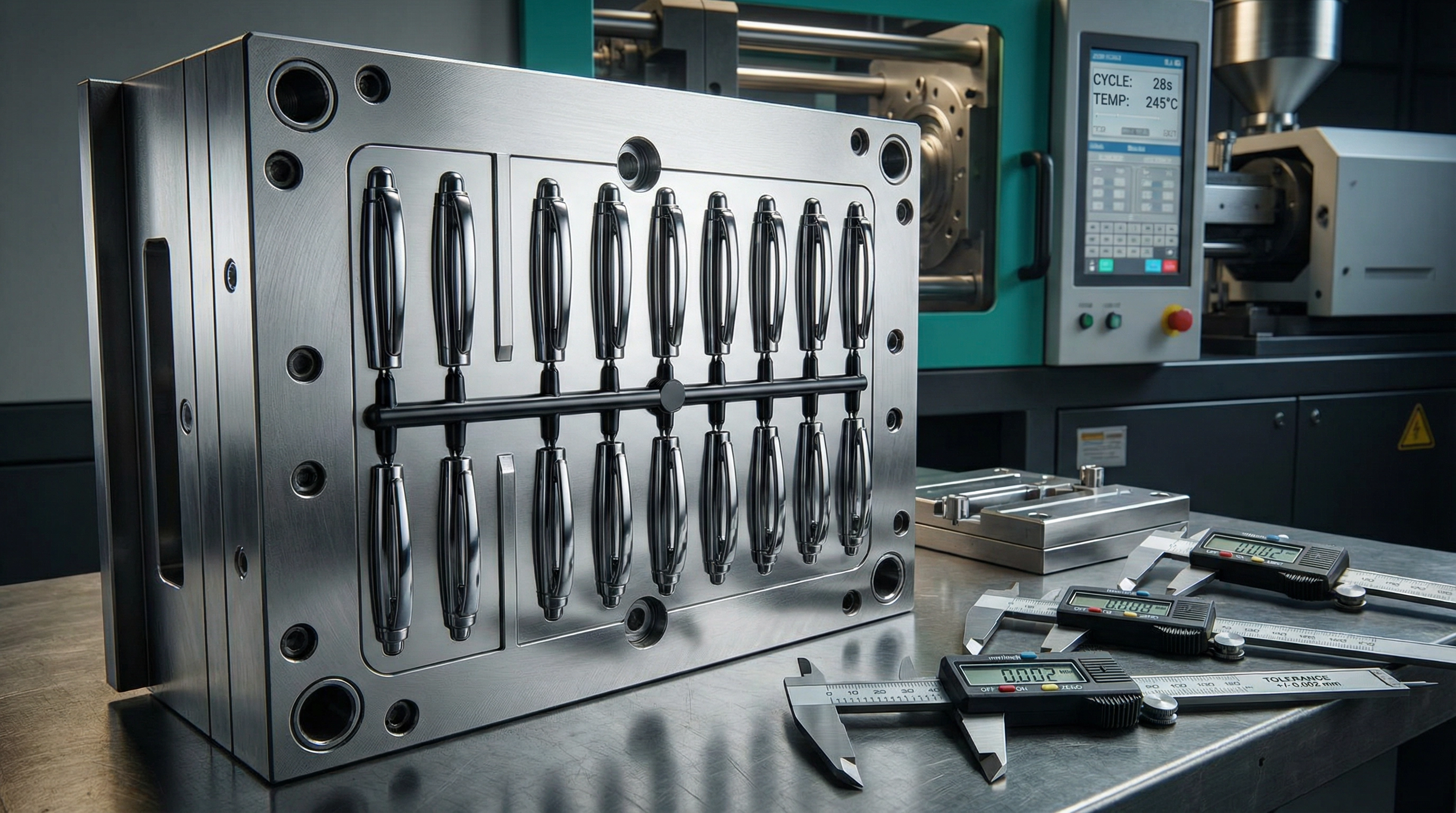
In 2024, a Chinese pen manufacturer invested USD 68,000 in a 32-cavity mold for producing promotional pen clips, expecting to double their output while maintaining the dimensional consistency they'd achieved with their existing 16-cavity tool. Three months into production, their rejection rate had climbed from 2.1% to 8.7%, and their largest client—a Singapore corporate gifting distributor—had placed their account on quality hold after receiving a batch where 14% of clips failed the snap-fit retention test.
The problem wasn't the mold builder's competence or the material specification. It was a fundamental misunderstanding of how cavity count affects dimensional consistency in precision injection molding. Every additional cavity introduces new variables in melt flow, cooling rate, and packing pressure distribution. Beyond a certain threshold—typically 16-24 cavities for thin-walled components like pen clips—the challenge of maintaining uniform conditions across all cavities exceeds the economic benefit of higher output.
This isn't a theoretical concern. It's the difference between a mold that produces saleable parts and one that generates expensive scrap while your capital equipment sits idle troubleshooting quality issues.
Why does dimensional consistency degrade as cavity count increases?
Injection molding relies on filling multiple cavities simultaneously with molten plastic, then holding pressure while the material cools and solidifies. In a perfect world, every cavity receives identical melt temperature, injection pressure, packing pressure, and cooling rate, producing parts with identical dimensions. In reality, the melt must travel through a runner system to reach each cavity, losing heat and pressure along the way. The cavities closest to the injection point (gate) receive hotter, higher-pressure melt than cavities at the end of the flow path.
This pressure and temperature gradient causes dimensional variations between cavities. In a well-designed 8-cavity mold, the difference might be 0.02-0.04mm on critical dimensions. In a poorly designed 32-cavity mold, that difference can reach 0.15-0.20mm—enough to cause functional failures in precision components like pen clips where the snap-fit engagement typically has only 0.25mm of tolerance.
The Chinese manufacturer's 32-cavity mold used a traditional branching runner system where the melt flowed from a central sprue into progressively smaller branches feeding pairs of cavities. By the time melt reached the outermost cavities (positions 29-32), it had traveled 340mm through runners, losing 18°C in temperature and experiencing a 12% pressure drop compared to the innermost cavities (positions 1-4). The result: cavities 1-4 produced clips with a spring arm thickness of 0.82mm, while cavities 29-32 produced 0.76mm—a 0.06mm variation that caused the thinner clips to fail retention testing.
The irony is that their 16-cavity mold, with its shorter runner system and lower cavity count, had maintained thickness variation under 0.03mm. Doubling the cavity count didn't double their output—it halved their yield.
Cavity Balancing: The Non-Negotiable Foundation
Cavity balancing ensures that every cavity receives melt at the same temperature, pressure, and flow rate. This requires three design elements working in concert: geometrically balanced runners, identical gate locations, and matched cavity surface finishes.
Geometrically Balanced Runners mean that the flow path from the sprue to each cavity is identical in length and cross-sectional area. The simplest approach is a radial layout where cavities are arranged in concentric circles around a central sprue, with each cavity fed by a runner of equal length. This works well for up to 12-16 cavities but becomes geometrically impractical beyond that because the outer ring of cavities requires excessive mold plate size.
For higher cavity counts, mold designers use a "family tree" runner architecture where the primary runner branches into secondary runners, which branch again into tertiary runners feeding individual cavities. The critical requirement is that every branch point divides the flow equally. If the primary runner splits into two secondary runners, each secondary must feed exactly half the total cavities. If one secondary feeds 10 cavities and the other feeds 6, the flow resistance will differ, causing pressure imbalance.
The Chinese manufacturer's mold violated this principle. Their primary runner split into four secondaries feeding 10, 8, 8, and 6 cavities respectively. The 10-cavity branch experienced higher flow resistance, resulting in lower pressure and cooler melt temperatures in those cavities. Correcting this required rebuilding the runner system to feed 8 cavities per branch (32 total), which meant scrapping the existing mold base and starting over—a USD 42,000 loss.
Identical Gate Locations ensure that melt enters each cavity at the same position relative to the part geometry. This matters because gate location affects how the melt front propagates through the cavity, which in turn affects molecular orientation, residual stress, and final dimensions. A pen clip gated at the base will have different mechanical properties than one gated at the tip, even if both are dimensionally identical.
Most pen clip molds use edge gates positioned at the base of the clip (the end that attaches to the pen barrel) because this location minimizes visible gate vestige and allows the melt to flow naturally along the clip's length. In a multi-cavity mold, every cavity must have its gate at exactly the same relative position—not just "approximately at the base," but at precisely the same distance from the clip's mounting hole and the same angle relative to the spring arm.
I audited a Vietnamese mold in 2023 where the mold builder had positioned gates "by eye" rather than using CNC coordinates. The gate positions varied by up to 1.2mm between cavities. This caused the spring arm's engagement feature to vary in position by 0.08mm—enough to cause intermittent assembly failures where clips wouldn't snap properly onto pen barrels. Remachining all 24 gate locations to a common coordinate reference cost USD 8,400 and required three weeks of downtime.
Matched Cavity Surface Finishes affect how quickly heat transfers from the molten plastic to the mold steel, which affects cooling rate and final dimensions. A cavity with a rougher surface finish (Ra 0.8 µm) will transfer heat slightly faster than a polished cavity (Ra 0.2 µm) because the microscopic peaks in the rough surface create more contact points with the plastic. This difference is small—typically 2-3% in cooling rate—but it compounds over thousands of cycles and can cause measurable dimensional drift.
High-quality mold builders specify surface finish tolerances (e.g., "all cavity surfaces Ra 0.4 ± 0.1 µm") and verify them with profilometers after polishing. Budget mold builders polish "until it looks good" and hope for the best. The difference shows up in your rejection rate six months into production when some cavities start producing parts that are 0.04mm oversized because their slower cooling allows more thermal expansion.
Runner Design: Hot vs Cold and the Trade-Offs
Runner systems come in two fundamental types: cold runners (where the plastic in the runner solidifies and is ejected with each shot) and hot runners (where the runner is heated to keep plastic molten between shots). Each has profound implications for cavity balancing and dimensional consistency.
Cold Runners are simpler and cheaper to build (typically USD 15,000-25,000 less than equivalent hot runner molds) but generate material waste because the solidified runner must be separated from the parts and either recycled or discarded. For a 16-cavity pen clip mold, the runner system might weigh 45 grams while the 16 clips weigh 32 grams total—you're using more material for the runner than for the actual parts.
This waste matters economically (material cost) and environmentally (many corporate clients now audit supplier material efficiency). But cold runners have a hidden advantage for dimensional consistency: because the runner solidifies between shots, it acts as a pressure buffer that helps equalize filling across cavities. The solidified runner creates flow resistance that dampens pressure variations, making cold runner molds more forgiving of minor imbalances in runner geometry.
Hot Runners eliminate material waste by keeping the runner molten, but they introduce new complexity. Each cavity requires a heated nozzle (called a drop) that maintains precise temperature control. If drop temperatures vary by more than ±3°C between cavities, you'll get dimensional variations. Hot runner systems also cost USD 18,000-35,000 more than cold runners for a 16-cavity mold, and they require more maintenance because heater failures and temperature controller malfunctions are common failure modes.
The Chinese manufacturer chose a hot runner system for their 32-cavity mold to eliminate material waste (their client's sustainability audit had flagged runner scrap as a concern). However, their hot runner controller had only 8 zones, meaning each zone controlled 4 drops. When one drop in a zone required higher temperature to compensate for heat loss, all 4 drops in that zone received higher temperature, causing dimensional variations. Upgrading to a 32-zone controller (one per drop) cost USD 12,000 but was essential to achieving acceptable dimensional consistency.
The decision between hot and cold runners isn't purely technical—it's economic. Cold runners make sense when:
- Material cost is low relative to mold cost
- Cavity count is under 16 (where runner waste is proportionally smaller)
- Dimensional tolerances are tight (cold runners are more forgiving)
- Maintenance capability is limited (cold runners have fewer failure modes)
Hot runners make sense when:
- Material cost is high or client requires waste reduction
- Production volume is very high (millions of parts annually)
- You have skilled maintenance staff who can troubleshoot temperature control issues
- Cycle time reduction is critical (hot runners save 3-5 seconds per cycle by eliminating runner cooling time)
Cooling System Design: The Hidden Determinant of Consistency
Cooling accounts for 60-70% of injection molding cycle time, and cooling rate directly affects part dimensions through thermal shrinkage. A pen clip that cools faster will shrink less than one that cools slowly, even if both start with identical melt temperature and packing pressure. In a multi-cavity mold, achieving uniform cooling across all cavities is often harder than achieving uniform filling.
The challenge is geometric: cooling channels must be drilled through the mold steel, and drilling paths are constrained by the mold's structural requirements (you can't drill through ejector pins, runner channels, or mounting holes). This means cooling channels can't always be positioned optimally relative to each cavity. Some cavities end up with cooling channels 12mm from the cavity surface, while others have channels 18mm away. The difference in cooling efficiency causes dimensional variations.
Advanced mold designs use conformal cooling—channels that follow the contour of the cavity surface at a constant distance—fabricated through additive manufacturing (3D printing) of mold inserts. This technology has transformed high-precision molding since 2020, but it's expensive: conformal cooling adds USD 8,000-15,000 to mold cost for a 16-cavity tool. For commodity parts, it's not economical. For precision components where dimensional consistency determines functionality, it's often essential.
A Malaysian pen manufacturer I worked with in 2024 was struggling with a 24-cavity clip mold where 6 cavities (positions 19-24) consistently produced clips that were 0.05mm shorter than the other 18 cavities. Mold-flow simulation revealed that those 6 cavities were cooling 15% faster because they were positioned near the mold's water inlet, receiving cooler water than cavities near the outlet. The solution was to add a secondary cooling circuit with its own temperature controller, feeding cavities 19-24 with slightly warmer water (22°C vs 18°C for the main circuit) to equalize cooling rates. This modification cost USD 6,200 but eliminated the dimensional variation.
The lesson: cooling system design isn't just about removing heat—it's about removing heat uniformly across all cavities. This requires:
- Balanced coolant flow rates to each cavity
- Consistent coolant temperature (±1°C) throughout the system
- Equal cooling channel proximity to cavity surfaces
- Adequate coolant flow velocity (typically 3-5 liters/minute per circuit) to ensure turbulent flow and efficient heat transfer
Most mold builders focus on filling and packing (the visible parts of the molding process) and treat cooling as an afterthought. The best mold builders design the cooling system first, then work backward to accommodate it in the mold structure.
Material Selection and Its Interaction with Cavity Count
Pen clips are typically molded from ABS, polypropylene, or polycarbonate, each with different shrinkage characteristics that interact with cavity count in non-obvious ways. ABS shrinks 0.4-0.7% as it cools, polypropylene shrinks 1.0-2.5%, and polycarbonate shrinks 0.5-0.7%. These shrinkage values are averages—actual shrinkage depends on cooling rate, packing pressure, and molecular orientation, all of which vary between cavities in a multi-cavity mold.
Polypropylene's high shrinkage makes it particularly sensitive to cavity-to-cavity variations. A 50mm long pen clip molded in PP will shrink 0.5-1.25mm during cooling. If cavity 1 cools 10% faster than cavity 16 due to cooling system imbalances, the shrinkage difference will be 0.05-0.125mm—potentially enough to cause functional problems. ABS and PC, with their lower shrinkage rates, are more forgiving of cooling variations.
This is why most high-volume pen clip molds use ABS despite its higher material cost (USD 2.20/kg vs USD 1.60/kg for PP). The dimensional consistency is worth the 38% material cost premium. PP is reserved for applications where chemical resistance or living hinge functionality is required, and those applications typically use lower cavity counts (8-12 cavities) to maintain acceptable dimensional control.
The Chinese manufacturer's mold was designed for ABS but their client requested a cost reduction, leading them to switch to PP without modifying the mold's cooling system. The higher shrinkage of PP amplified the existing cooling imbalances, turning a marginal dimensional variation into a critical quality issue. Switching back to ABS resolved the immediate problem, but the proper solution would have been to redesign the cooling system for PP's higher shrinkage sensitivity.
Economic Analysis: When Does Higher Cavity Count Stop Making Sense?
The economic logic of multi-cavity molds seems straightforward: doubling cavity count doubles output, halving the per-part cost. But this assumes that dimensional consistency remains acceptable, which often isn't true beyond a certain cavity count.
A realistic economic model must account for:
- Mold cost scaling: Mold cost doesn't scale linearly with cavity count. A 32-cavity mold costs 2.2-2.8x as much as a 16-cavity mold (not 2.0x) because of the increased complexity in runner balancing, cooling design, and quality control during mold fabrication.
- Rejection rate increases: As cavity count rises, rejection rates typically increase due to dimensional inconsistencies. A 16-cavity mold might achieve 2% scrap, while a 32-cavity mold might see 6-8% scrap, eroding the output advantage.
- Troubleshooting downtime: Higher cavity count molds are harder to troubleshoot when problems occur. Identifying which cavity is producing defective parts, and why, takes longer when you have 32 suspects instead of 8.
- Maintenance complexity: More cavities mean more potential failure points. Ejector pins break, cooling channels clog, and gate wear occurs. A 32-cavity mold has 4x as many ejector pins as an 8-cavity mold, quadrupling the probability of ejector-related downtime.
I ran a TCO analysis for a Thai pen manufacturer considering whether to build one 32-cavity mold or two 16-cavity molds for a promotional clip program. The results were counterintuitive:
Option A: One 32-Cavity Mold
- Mold cost: USD 68,000
- Cycle time: 28 seconds (longer due to cooling challenges)
- Rejection rate: 6.5% (based on similar molds)
- Annual output: 4.2 million parts (accounting for downtime and scrap)
- Cost per part: USD 0.0162
Option B: Two 16-Cavity Molds
- Mold cost: USD 84,000 (USD 42,000 each)
- Cycle time: 24 seconds per mold
- Rejection rate: 2.2% per mold
- Annual output: 4.6 million parts (both molds combined)
- Cost per part: USD 0.0183
Option A appeared cheaper per part, but the analysis changed when we factored in quality holds and customer complaints. The 32-cavity mold's higher rejection rate caused three quality holds over 18 months, each lasting 4-7 days while root causes were investigated. These holds cost USD 28,000 in lost production and expedited shipping to recover delayed orders. The 16-cavity molds experienced only one quality hold (2 days) costing USD 6,000.
Including quality hold costs, Option B's true cost per part was USD 0.0196, while Option A's was USD 0.0229—making the two-mold approach 14% cheaper despite higher capital cost. The client chose Option B and has since reported 99.1% on-time delivery versus 94.7% before the mold upgrade.
Practical Guidelines: Choosing the Right Cavity Count
Based on 23 pen clip mold projects across Southeast Asia and China between 2021-2025, I've developed cavity count guidelines that balance output with dimensional consistency:
8-Cavity Molds:
- Best for: Prototype tooling, low-volume specialty clips, ultra-tight tolerances (±0.03mm)
- Typical cost: USD 22,000-32,000
- Achievable rejection rate: <1.5%
- When to use: Annual volume under 500,000 parts, or when dimensional consistency is more critical than output
16-Cavity Molds:
- Best for: Standard production, balanced cost and quality
- Typical cost: USD 38,000-52,000
- Achievable rejection rate: 1.8-2.5%
- When to use: Annual volume 500,000-3,000,000 parts, this is the "sweet spot" for most applications
24-Cavity Molds:
- Best for: High-volume production with experienced mold builder
- Typical cost: USD 55,000-75,000
- Achievable rejection rate: 2.5-4.0%
- When to use: Annual volume 3,000,000-6,000,000 parts, and you have proven capability to manage complex tooling
32+ Cavity Molds:
- Best for: Ultra-high volume commodity parts where dimensional tolerances are relaxed
- Typical cost: USD 70,000-110,000
- Achievable rejection rate: 4.0-8.0%
- When to use: Annual volume exceeds 6,000,000 parts, part function isn't sensitive to 0.08-0.12mm dimensional variations, and you have advanced process control capabilities
The Chinese manufacturer's mistake was jumping from 16 to 32 cavities without the process control infrastructure to manage the complexity. A staged approach—16 to 24 cavities first, then 24 to 32 after proving capability—would have avoided the quality crisis and USD 42,000 mold rebuild.
Future Directions: Digital Twin and Adaptive Process Control
The next frontier in multi-cavity molding is real-time adaptive control using in-mold sensors and AI-driven process adjustment. A Taiwanese mold builder I'm working with has developed a 20-cavity pen clip mold with pressure and temperature sensors in each cavity, feeding data to a control system that adjusts injection speed, packing pressure, and cooling time on a cavity-by-cavity basis.
The system detects when cavity 14 is running 0.02mm oversized and automatically reduces its packing pressure by 3% while increasing cooling time by 0.4 seconds. Meanwhile, cavity 7 is running 0.01mm undersized, so its packing pressure increases by 2%. These micro-adjustments happen every 5-10 cycles based on statistical process control algorithms, keeping all 20 cavities within ±0.02mm despite variations in material lot, ambient temperature, and machine wear.
This technology isn't cheap—the sensor package and control system add USD 28,000 to mold cost—but it's transforming what's achievable in high-cavity molding. Rejection rates that were 4-6% with conventional process control drop to 1.2-1.8% with adaptive control. For high-value parts or applications where customer quality holds are expensive, the ROI is compelling.
Within 5-10 years, adaptive process control will likely become standard for molds above 16 cavities, just as hot runners became standard for high-volume production in the 2000s. The economics are following the same trajectory: initially too expensive for mainstream adoption, but costs declining rapidly as sensor and computing technology improves.
Related Articles: